Showing posts with label struggles. Show all posts

Monday, 24 December 2012

dispatch from spain


[Last autumn, a new and awful form of protest came to Spain. A string of homeowners on the verge of eviction by court orders and the riot police (antidisturbios) committed suicide by leaping from the windows of their mortgaged houses. The growing anti-eviction movement has altered the dynamic of social protest in Spain, broadening and deepening the opposition to austerity already manifested in the 15M and 25S movements. In the general strike of 14 November, called for by the largest unions, ‘everyone except the Partido Popular and Basque nationalist unions’ poured into the streets. Darío Corbeira, editor of Brumaria, sends the following reflection on the context of the unfolding social struggle. Many thanks to him for taking the time, and to Maria Adelaida Samper for the fine translation. –GR]


Hermeneutic Antidisturbios: 25S, the Anti-Eviction Movement and the 14 November General Strike in Context

By Darío Corbeira


On 25 September, several thousand citizens responded to an anonymous call to surround Madrid’s Congress of Deputies: ‘Surround the Congress, remain there indefinitely. Desert and break with the current regime, demand the dissolution of the entire government, courts and heads of state, and abolition of the existing Constitution. Begin constituting a new system of political, economic and social organization.’The gathering citizens aimed to convey to the parliamentarians their deep opposition to the austerity program of Mariano Rajoy Brey’s governing Partido Popular (PP) and to the interventions of the European Central Bank, International Monetary Fund and European Union. Framing it was a radical critique of the parliamentarism that came out of the so so-called Transition to democracy. As made clear in their manifestos, proclamations and chants, the protesters saw that form of democracy as utterly bankrupt. What began that day has become known as the 25S movement, distinct from but clearly related to its predecessor 15M and the other movements that have emerged from the neighbourhoods, universities, hospitals, cultural centers, and manufacturing areas. All were questioning the perverse effects of neoliberal policies designed by financial capitalism and applied to the letter by the governing authorities. Those effects have shaken the fragile ‘welfare state’ slowly built up since Franco’s death and have undermined all it has achieved by way of diminishing the gaping social and economic disparities that persist in Spain despite the governments of the Partido Socialista Obrero Español (Spanish Socialist Worker’s Party/PSOE).

The peaceful and festive demonstration of 25S, which only pretended to circle the public building and deliver a text addressed to the deputies, was blocked from entering nearby areas of Congress by security fencing and a force of more than 2000 riot police – the antidisturbios. A small attempt to force the fences was enough for the riot cops to unleash a repressive violence not seen in Spain since the last gasps of Franco’s dictatorship. It is worth noting that the Interior Minister, responsible for the State’s security forces, is a prominent member of Opus Dei. Days before the call, both the General Secretary of the PP and the Government Delegate in Madrid were warming up by condemning the foreseeable protestors as ‘violent and anti-system’. This formula, the insult of choice of the authorities and the more reactionary media, now acquires a new and strong semantic value. The demonstration on 25 September ended with more than a hundred protesters wounded or arrested. The latter were packed off to the National Court, a tribunal specifically convened to try crimes of terrorism. This court, however, decreed their release, and the case against them was filed by a writ in which the judge, in an unprecedented act, adopted the words of those who had convened the demonstration: ‘the agreed upon decay of the so-called political class.’ What today is a known secret had burst into view: holding diverging views about the causes and proper administration of the economic crisis of 2008, the executive and the judicial powers are heading for a confrontation. Police brutality and the judicial response gave wings to the protesters, who now began to call themselves the 25S movement.

   
From that point on, in the media and in the spheres of power and its opposition, a debate was generated that was as false as it was unproductive: the debate on ‘violence’- a violence that among the demonstrators was clearly non-existing. Without running away from court dates and futile debates, the activists of 25S continued to convoke new demonstrations to circle Congress, also peaceful, albeit with thinning numbers. By this it gave practical proofs that the crux of the protest and disobedience was not violence, but the subsidiary role that politicians accepted for managing a crisis whose authors were sleeping soundly in the clouds of the financial firmament. The protesters of 25S, as those of 15M had done a year before, were provoking a discussion about the limits of Spain’s capitalist-parliamentarian democracy – about its obsolescence as an instrument for representation. At the same time, demands for new forms of exercising citizenship were put forward, aiming for greater participation in decision-making.

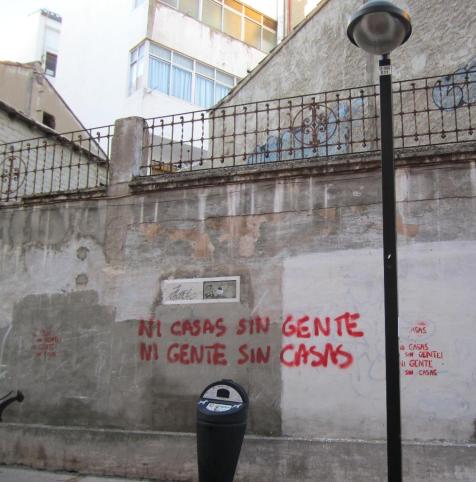
In Spain, as elsewhere, the population had experienced growing rates of unemployment, poverty and precarious employment, in conjunction with cutbacks and the privatization of public services. While public money counted in astronomical figures is being injected into bankrupt banks, the government promulgates a nineteenth-century labour reform, devastates the job security of civil servants and arranges fiscal amnesty for all those who have looted the public treasury. In the middle of it all, the desahucios (foreclosures) erupt, making visible the exemplary struggle of anonymous citizens, supported by a Left recomposing itself outside the countours of Social Democracy. The desahucio is a perversely materialistic legal concept through which citizens are expelled from their houses when they cannot make scheduled payments on the loans they acquired in buying their first longed-for home during the property boom.


From Parliamentary Democracy to Godfathers and Galactic Entrepreneurs

To understand how it has come to this, we must go back to the beginning of the two presidencies of José María Aznar (1996-2000 and 2000-2004), as well as the two of José Luis Rodríguez Zapatero, (2004-2008 and 2008-2011). In the expansive cycle spanning the period from 1996 to 2007, the Spanish economy registered an average annual GDP growth rate of 3.5%, driven mainly by the construction sector. During these years, more housing was built in Spain than in Germany, France, Italy and the United Kingdom put together. And there was in addition an exponential growth in worksof infrastructure and public buildings. All this development took place under the shelter of low interest loans subsidized by the European Union, in conjunction with the neoliberal fiscal policies pursued by the parties in the Spanish government (the PP and the PSOE), and with the Euro as exchange currency. José María Aznar was the architect of the transformation of the PP, a drifting party in the beginning of the 1990s, into to what it is today: the largest political party in Europe. An explosive mix of residual franquismo, Chicago/Harvard neoliberalism and Italian Cosa Nostra, the PP operates an extensive clientelist network of ‘militants’ who occupy, thanks to the method of direct appointment, prominent places and positions in Central, Autonomous and Local administrations. All of this endows the party’s leadership and propaganda apparatus with an hegemonizing power to impose its reactionary and hyper-liberal discourse on political life.

In the expanding cycle of 1996-2007, fiscal and monetary policies were applied in accordance with the so called ‘property boom’. Public entities, banks, construction companies large and small, families and private individuals all entered into a perverse game in which housing prices rose steadily and home ownership produced wealth and guaranties for the future. By 2006, the paradoxical character of this bubble had become visible: more than 2.5 million houses, excessively priced and unsold, sat empty, while at the same time millions of young people, professionals and families were priced out of access to even a small-sized first home. Public housing initiatives were merely nominal, and the big construction companies, supported by indulgent building codes and a continuous flow of cheap money, had a free hand to inflate a rampant market. Meanwhile, taxes on millions of real estate transactions provided the Local municipalities and Autonomous and Central administrations with the economic resources to alleviate public deficits, restructure budgets and increase social expenditures. To supply the vast labour needs of the brick and concrete industries, now growing at an accelerated rate, a cheap low-skilled workforce was needed. And so Spain, which until the middle of the 1970s was still exporting workers to Switzerland, the UK, Germany, Netherlands and Holland, now became host to immigrant labourers from Latin America, North Africa and Eastern Europe. The construction sector, whose motto was ‘more’ – more growth, more money, more public and private works - kept going like this until it ventured into the financial markets, into telecommunications and new technologies, into the oil sector, and into the realm of sports, above all football.


As a tragic anecdote, it is worth recalling that José Luis Rodríguez Zapatero, while still in office, declared that midway through his first presidency, Florentino Pérez (a major construction tycoon and at the time president of Real Madrid C.F.) came to see him at the Palacio de Moncloa and told him: ‘Either you make the Emigration Law more flexible or I’ll go directly to the boats to hire Blacks.’ This disclosure, uttered by Zapatero with his characteristic idiot smile, reveals both the illegal labour practices of an unscrupulous builder and the whole poignant tragedy of the thousand of Sub-Saharans who, seeking places in this overexploited labour market, drowned in the Straits of Gibraltar while trying to reach the Spanish coast.

That Florentino Pérez was also president Real Madrid C.F. is no trivial factoid. It is crucial for understanding this historical period, its suprainstitutional latticework and modes of interaction between economic power and the State – in short, the whole process that led from parliamentary democracy to financial oligarchy. For the third issue of Brumaria (2003), one of the most prominent architects of the PSOE offered this commentary on the already disproportionate property bubble: ‘A central laboratory for decisions was missing, a think tank of neo-conservative thought, and they found it: the box of Real Madrid, the urban cathedral for the new economic and political power, the transversal cockpit of the new order. There they sit together: the politicians (those who let themselves, which are many), the major entrepreneurs of the buddies capitalism that the PP has provided, the King if needed. And there, the politicians of PRISA rub shoulders with recycled unionists, while politicized journalists and galactic businessmen [the Real Madrid football team is called ‘the White Galaxy’ by its fans] cheer the super-transfers that indicate that the network is prospering. In that dammed box, between scores, building floors are reclassified, public works are awarded, companies are sold and decisions are made concerning which candidate from which party is more convenient for the team of the football fans.’


‘The Madrid administrations have gone mute about what makes the discourse public and compensatory in matters of the common, and in that box there is no talk about Madrid (what belongs to all) but of business in Madrid. To them, the city is a cow that needs to be milked and the greatest effort in imagination they are willing to make, consists in packing the cow with more tits than the poor animal naturally has. It is about having enough tits for all the friends of the galaxy. Goal!!’

In that football box, in fact, the sacrosanct alliance was made between financial capital, political power, monarchy and all kinds of monied upstarts. As I write this text in early December 2012, the media are spitting out non-stop the news of the arrest, by order of the National Court, of Gerardo Díaz Ferrán, president of the Spanish Confederation of Financial Organizations(CEOE) from 2007 to 2010. He is accused, among other crimes, of money laundering and concealment of assets following the bankruptcy of his business empire in 2010. Díaz Ferrán was a friend of top politicians in the PP and PSOE, and an overly qualified representative of the predation-and-ruin entrepreneurship that led the growth boom of new-millennium Spain. To him we owe the famous formula, addressed to the unions, for solving the crisis: ‘You have to work more and charge less.’ Some argue that capitalism does not know how to solve the current systemic crisis. But one wonders if this repulsive formula of Díaz Ferrán is not proof that it intends to resolve this crisis as it has all the others before it. The Sunday before his arrest, Díaz Ferrán went to Madrid’s Royal Theater to attend a production of Verdi’s Macbeth. There he met Alberto Ruiz Gallardón, current Minister of Justice (The Godfather, Part IV). The now-incarcerated businessman certainly took note of the dying Macbeth’s final aria in Act IV: ‘Bad for me that I trusted the prophecies of hell.’ Remembering the final sequences of The Godfather, Part III, on the stairs of Palermo’s Opera House, where Michael Corleone’s and Don Altobello’s hitmen resolve their differences with the dialectics of weaponry while Pietro Mascagni’s Cavelleria Rustica plays in the background, one cannot help imagining a group of radicalized militants splintered from the movements, gathering armed and hooded outside Madrid’s Opera to deliver their political message to the powerful thieves who are afflicted by Verdi while they plunge into ruin the Kingdom of Spain.


Money, Death and Desahucio, or The Right to Housing Negated

All through the boom years, works were undertaken on a pharaonic scale: airports were built, high speed trains, universities, museums and contemporary art centres, all drawing on the cheap money dictated by the European Central Bank. In 2008 the sub-prime mortgage crisis erupted and began to spread, exposing the volatility and fragility of social and economic policies steered by hegemonic financial capitalism. Now dragged into the light of day: the criminal activity of its executives and the genuflections before it of the media and the executive, legislative and judicial powers of the Western democracies.  

In Spain, the social effects of the crisis continue to be lethal: 9000 new unemployed every day, one in two young people unable to find a job, the steady rise of public and private debt, the technical bankruptcy of most of the financial institutions, negative economic growth, the systematic dismantling of an already weakened welfare state, the widening of income disparities, and, most dramatic of all, the resurgence of a poverty and misery absent since the late 1950s.


In Spain the narratives (and the portraits) of financial economy, politics and culture coincide; they fade and reappear in the time- and space-unities of the present, tracing the ideological substratum of late neoliberalism. The appearance, subsidence and hibernation of the 15M movement, the eruption of 25S, and the proliferation of social forums and assemblies only confirm that the wretched of the earth have yet to find their Paradise. And what has the long boom to show for itself now: more than three million empty homes, new airports that have closed or that never became operational, high speed train lines shut down for lack of travellers, new university buildings empty and without students. And the museums and contemporary art centres (over 100 museum infrastructures built and launched during the same period)? Like ETA they refuse to die, not wanting to realize that the crisis of 2008 had been preceded, with regard to art and culture, by the exhaustion of the post-Franco model of cultural production. In the context of neoliberal privatization, art no longer fulfils its role as agent of metaphor construction, polltaker of reality, and interrogator of unjust and improvable conditions. Art, as system and institution, emerges now as an integral and collaborative part of the ideological apparatus of a State that administers as it can the disasters of a growth pursued heedless of cost.


In the devastating conjunction of forced judicial evictions, millions of empty houses and the unmet need for housing, all the corrupt and contradictory strands of the crisis and its preludes are woven together. The 1978 Constitution guarantees the right to housing in unequivocal terms: ‘The whole of the Spanish people have the right to enjoy fair and adequate housing. The public powers will promote the necessary conditions and will establish pertinent measures to enforce this right, by regulating the land use in accordance with the general interest to impede speculation. The community will participate in the capital appreciation generated by the urban action of public Entities.’ (Article 47)
    
However, the facts, including all the administrative measures and policies carried out since 1996, violate this article point by point, and ‘the public powers’ have done nothing legislatively or economically to guarantee the right enshrined in it. Consequently, millions in Spain have no access to fair and adequate housing. The successive building laws of the different Autonomous regions have turned all Spanish territory into ‘developable land’, with the exception of specially protected areas. Speculation has been actively encouraged. And of course, there has been no participation whatsoever of the community (what community?) in the capital gain that was generated during the bullish period – the diabolic relation between public administrations, banks, and construction and real estate firms has seen to that. A strict and disorderly speculative relation, in short, sponsored and promoted from the misted heights of the financial framework.


Already this autumn, more than ten people, behind in mortgage payments and facing forced eviction from their homes, have killed themselves. Money and death, hand in hand, are returning us to a tragic Spain that, naively, we thought we had overcome. Are money and death the same thing perhaps? Once more in our heads, that line from Godard’s great Film Socialisme is resounding: ‘Money was invented so that men cannot look each other in the eye.’ The poor wretches who are ending their lives when threatened with eviction by court orders are doing it in the most brutal, poignant and significant way: by throwing themselves from the windows of their own unpaid homes. Before a judge can expel them, they go out by themselves, out of their homes and their lives. Each time he gets drunk, which is quite often, an art critic friend has been declaring, ‘Since the death of Stalin, the working class gets disrespected.’ Years later Alain Badiou tells us, ‘If I can admit Stalin for something, it is because the capitalists were afraid of him.’ Wouldn’t that, exactly, be part of it? That the agents of capitalism have lost their fear of the wretched of the earth?

But the evictions, in numbers that surpass half a million, haven’t appeared from one day to the next. It is at least demented that in a country like Spain, where the rate of private mortgage nonpayment is actually incredibly low, the evictions are being counted in hundreds of thousands and have become a political nucleus of action and reaction that has ended up drawing in all segments of the population. The origins of the desahucios (evictions) must be sought in the years of economic upturn, the era of the real estate boom, when economic, social, demographic and legal factors intersected, ultimately becoming an explosive mix of conflicting interests. The vast amount of housing built with cheap loans and lenient legislation had a referential basis in the Spanish collective imaginary: the dream of owning a home instead of renting it. The growth of mortgaged home ownership led to inflated housing prices and a market in speculation. The majority of the Spanish population, whether to buy a first home or for investment purposes, embarked on property purchases with the fast and cheap money put at their disposal. Some of these buyers were (and are) immigrants who came to Spain seeking their promised land. Already before 2007, the boom should have been seen for what it was - a balloon that could be punctured. Neither the Aznar nor the Zapataro government did anything to slow or deflate it, not even slightly. On the contrary, they encouraged the pumping of more air into it.


In 2007, the first winds of the coming storm appeared in the form of bankrupted financial institutions, millions of empty houses with no buyers in sight, high speed train lines carrying 16 commuters a day, closed airports, technically bankrupt universities and a population of unemployed nearing four million. The ones who first saw the magnitude of the crisis were the banking institutions that had, with cheap money, structured their business on credits and investments in the construction sector, with no hedges on the risks entailed. The results: families and individuals unable to meet monthly mortgage payments, indebted public and private corporations soon in the same predicament, and insolvent public administrations that hadconstantly to go to ‘the markets’ to raise the money to service their debts. In the media, the big subject of the past four years made its appearance: the ‘risk premium’, in the spotlight of an uncertain future. As the State stepped in to cover private sector debt – that of the banks, primarily – the public debt, initially eight times smaller than private debt, started its upward climb. Meanwhile the Kingdom of Spain (in the last days of Zapatero and during the first year of Mariano Rajoy’s government) obediently implemented the measures imposed by the Troika, namely, the wish list of borderless financial capitalism. This delegation of governance and sovereignty to Brussels showed how far Spain’s democracy had become an anachronistic ideological souvenir.
    
All of this should matter little to those citizens who, after losing their jobs and falling too far behind on their mortgage payments, stood facing a judicial and administrative magma that in the end would expel them from their houses: no home, no job, no future. The evictions triggered by mortgage default have been piling up with no distinction made between first homes and housing investments. In force is a Mortgage Act dating back to 1909 and partially reformed in 1946, when the relationship between banks and homeowners was radically different from that of today. In it, all possible guarantees are given to the credit institution for collecting their receivables on the value of the asset in dispute, in this case the home. It is astonishing but true, in fact a real infamy, that if a homeowner cannot pay three instalments of his mortgage, the interest on late payments becomes 29.5%, and applies to the whole of the pending credit, while for that same money the banks have paid a mere 1.5% interest to the European Central Bank. And these same banks, of course, are being rescued and bailed out by public money. In the past four years, banking institutions, supported by this unjust and outdated law, have turned mortgaged property into a surplus-generating commodity, and in this the justice administration has played a key role. The issue now is that the banks, in their drive for capital accumulation and their propensity to usury, have in the last two years begun to lose control over the politics of mortgages and evictions. The articulation of civil solidarity, the 15M movement and the judge’s strike is confronting financial power and the government of the Kingdom of Spain with a new message and demand: evictions are not a Parcheesi game, and the interests of the most vulnerable must be safeguarded. Grounded in the remains of neighbourhood associations and mildly supported by the Izquierda Unida (United Left, IU), civil solidarity found a new impulse in the 15M movement. Militant actions against police and judicial measures began to proliferate.


Now, the protests and political actions of associations like ‘Stop Desahucios’ (Stop Evictions) and ‘Plataforma de Afectados por la Hipoteca’ (Platform of Those Affected by Mortgage) are manifesting a popular power that exceeds by far the merely symptom-signalling discourse of the 15M movement or, more recently, 25S. As the movement against evictions soars, the government and its allied media respond with a smear campaign: they are ‘violent and anti-system’, they are from the extreme left, banks have a duty to collect. Until the matter explodes in one of the three chapels of the system itself: judicial power. The judiciary is of course a traditionally conservative institutional network – the most liberal judges estimate that one in three Spanish judges are members of Opus Dei. But faced with the avalanche of eviction cases, the judges are saying, in effect, ‘Stop, these foreclosures and evictions are turning us into the banks’ collection agency.’ In Valencia, País Vasco and Madrid, the judges are requesting the government to change the laws; threatening to freeze pending cases, they are even calling for a moratorium on evictions. What no one would have dared imagine is happening: the four professional associations of judges and the three associations of prosecutors are all in agreement that the dynamic of evictions must be stopped. Moreover, although for different reasons, they are questioning Minister of Justice Albert Ruiz Gallardón, that wrecker of Madrid, ultraliberal and opera amateur. Even if without fully intending to, those selflessly struggling against the evictions are proving to be anti-systemic insofar as they collide with a System whose supports are crumbling. Rousseau and Montesquieu go on holidays could be the title of the movie. Regarding the Rajoy government’s program of austerity and cutbacks, the Minister of Justice has stated ‘Sometimes the government must distribute pain.’ Were Foucault to resuscitate in this moment, he would kill himself. As one of the fellows at Brumaria puts it, ‘It’s as though we were being governed by the Marquis de Sade.’

    
Questions: Re Pacifism, General Strikes and the Working Class

The Internet, as undiscriminating and random as it is empowering, is full of information and videos about the evictions. Just type the words ‘desahucios’ and ‘antidisturbios’ into any search engine and you will soon be watching clips that constitute the narrative documents of the current social and economical situation in Spain. These documents can and must be interpreted in political terms. Hence, the title of this text: Hermeneutic antidisturbios. The political actors, institutions and subsidiary elements on the ground can all be specified. On the one side, the evicted families, neighbours, anonymous citizens, activists and militants who try to block the progress of the other side, the legal secretaries and experts, locksmiths and officials duly accompanied and protected by units of anti-riot police. Again and again, the story is replayed: action and reaction, peaceful protest answered with violence, screams, running, beatings, people dragged through doors, blows, punches, arrests. Repressive force lurching reflexively to defend public order and, of course, guarantee that each home-commodity returns to the bank.

In all these small unfortunate episodes, the excesses of institutional and police violence are unmistakable. Beyond the interpretation of the obvious, in the functions and character of this violence, the need now is to ask questions about, and perhaps to set some limits, at least theoretically, to the pronounced pacifism of the new movements (of 15M, 25S and others). Similar questions and limits can be posed about the tendencies to treat the assembly-form as a panacea, to discuss horizontality as a paradigm, and to advance anti-politics as new political formula. But all that exceeds the limits of these reflections.

In this context, the largest unions called in mid-October for a general strike against the government austerity program. In the event, on 14 November, the traditional Left party, the anti-parliamentary Left party, the minor unions, the new movements, social forums, everyone joined this call – everyone except the governing PP and the Basque nationalist unions. At a time when the schools, universities, and above all the health sector are in continuously mobilisation, one in every three active workers joined the general strike. Two in every three who did not were prevented from doing so by pressure from employers. And finally, very important, the strike was followed 100% in the large factories and industrial belts. The question that now poses itself is as obvious as it is relevant, and as clear as it is difficult, not to say impossible, to answer: Where is the working class – had it not died, or mutated, or disappeared or been displaced?
    

Or must we, compelled by the evidence of events, speak of the working class as referent, even if without knowing very well (or any more) what we are referring to? Maybe should we forget about its strictly historical meaning, or talk more calmly of proletariat? Or erase it from the counter-hegemonic lexicon, as the inheritors of the inheritors of Autonomia Operaia have been doing? Isn’t it possible that the Working Class after all is refusing to die, even as the Multitude – despite the forceps work and c-sections that Occupy has been performing on the embarrassing pregnancy of political practice – has still not quite yet been born? In a last-minute paraphrase of Jacques Lacan, we are beginning to need a new mode of organizing around this void.

Madrid, December 2012.


Thursday, 13 December 2012

re third text


There is no more point in mincing words: the journal Third Text has been hijacked by its own Board of Trustees. The fiats of this administrative regime have, over the last two years, shut out founder Rasheed Araeen and turned over editorial control to a usurper whose abilities inspire little confidence and whose politics are dubious. This, in the name of bureaucratic values: "professionalization" and neo-liberal "governance." In the background, publisher Taylor & Francis and funding agency Arts Council England may have welcomed such changes, but for all those who know the history of this journal and value its committed critical vision, this takeover is unacceptable. 

Rasheed Araeen at Asia Art Archive, 2009

In the 1970s, artist Rasheed Araeen emerged as a leader in the struggle against institutionalized racism in the London art world. Positions first expressed in his 1975/6 "Preliminary Notes for a BLACK MANIFESTO," were developed in the late 1970s into the anti-imperialist Black Phoenix, and eventually, in 1987, into Third Text. Through the 1990s and into the new century, this journal nurtured many new voices, including my own, and was truly a forum for global critical perspectives on contemporary art and culture. Its feisty spirit was fed by its origins in struggle, and practical amnesia from above will not make this history disappear.


Funding cuts created the pressures and opening for this takeover, but the Trustees' unilateral actions were disrespectful, excessive and alienating to the Third Text community. Efforts to rescue the situation and work out a reconciliation continued through most of last Fall; by early December, it was clear that those who have seized control of the journal have no intention of restoring its postcolonial vision and critical integrity. Under this leadership, Third Text has lost its political credibility. Therefore: no more manuscripts, no more submissions. Meanwhile, Routledge T&F's monopolizing appetite for academic journals encourages the reduction of critical thought to a standardized plurality of brand names. In the context, this is a real loss, and an independent successor journal is urgently needed.
GR

For more, read Rasheed Araeen's 6 Dec. letter to Third Text supporters.

On 5 December, 18 out of 23 Third Text Advisory Council members collectively resigned and issued the following open letter (most of the TT Editorial Board having already resigned earlier).

Postscript: on 18 December Advisory Council member Ian McLean added his name to the open letter and resigned; only three members of the Advisory Council now remain with journal. -GR


Open Letter to the Trustees of Black Umbrella (Marjorie Allthorpe-Guyton, René Gimpel, Paul Goodwin, Joanna Mackle, Lord Bhikhu Parekh and Ziauddin Sardar):

5 December 2012

With this letter we announce our collective resignation from the Third Text Advisory Council.

With the full sadness of a long look back, we take our leave from a journal that has occupied a vital place in our critical lives and, for many of us, our artistic and intellectual formation. We do not leave gladly, but we are bound to accept that Third Text, under its current Trusteeship and editorial leadership, is no longer the journal we knew and loved.

By a series of unilateral actions, missteps, and a refusal of the spirit of consultation, current leadership has transformed Third Text from a committed and catalytic forum for critical postcolonial reflection to one more domesticated instance of neoliberal standardization. We are well aware of the funding pressures and administrative arguments that can be summoned to justify your actions and decisions. Indeed we are too well aware of them, since they have become the dominant norm in too many fields today. We are not, however, bound to accept or endorse them. We expect more than bureaucratic logic from those who would be the leaders of this journal, with its origins in anti-racial struggle and its two-decade history of critical commitments.

Taking into account all that has occurred and has come to light in the last two years, documented comprehensively in Jean Fisher’s report of 15 October 2012, and considering above all what you could and should have done to resolve the crisis of confidence that surrounds the journal, we find that your ‘final offer’ to Rasheed Araeen, dated November 2012, falls too short by far. In our letter of 13 August 2012, signed by a strong majority of the Advisory Council and some hundred Third Text associates, contributors and supporters, we made clear the conditions for an acceptable solution: having precipitated this crisis by your unilateral actions, the onus was on you to restore dignity to Rasheed’s role and reputation and to return his experience and editorial judgment to the journal, thereby reassuring us that its historical vision and integrity is being protected.

The steps by which you could have done so were outlined in Jean Fisher’s report. Rejecting them, your invocation of your legal obligations dresses up a mere assertion of control. Your overriding concern, as you repeatedly emphasize, has been to keep Routledge Taylor & Francis and Arts Council England happy. We are unconvinced by these self-exonerations. There was no communication with the Advisory Council regarding the situation at Third Text or the decisions you subsequently took; furthermore, the Trustees Board has acted unilaterally in what has been, over the last year, a major editorial reorientation of the journal – away from political and intellectual integrity and in the direction of an apolitical academic careerism bereft of that critical perspective for which Third Text historically stood.

With this transformation, we want nothing more to do. Kindly remove our names from the Third Text masthead and website without delay.


    Third Text Advisory Council Members:

Rustom Bharucha International Research Centre, Berlin, Germany
Guy Brett Honorary Professor, University of the Arts, London, UK
Denis Ekpo University of Port Harcourt, Nigeria
Geeta Kapur art critic and curator, New Delhi, India
Tabish Khair Aarhus University, Denmark
José-Carlos Mariátegui Editor, Tercer Texto, Lima, Peru
Gerardo Mosquera Havana, Cuba
Laura Mulvey Birkbeck, University of London
Benita Parry University of Warwick, UK
Howardena Pindell Stony Brook University, New York, USA
Mario Pissarra Africa South Art Initiative, Cape Town, South Africa
Gene Ray Berlin, Germany, and Geneva University of Art and Design, Switzerland
John Roberts University of Wolverhampton, UK
Gayatri Chakravorty Spivak Columbia University, New York, USA
Julian Stallabrass Courtauld Institute of Art, London, UK
Victor Tupitsyn Professor Emeritus, Pace University, New York, USA
Stephen Wright European School of Visual Arts, Paris, France
Slavoj Zizek Birkbeck Institute for the Humanities, University of London, UK, and University of Ljubljana, Slovenia


Wednesday, 14 November 2012

review: lilley et al on catastrophism


Review: Sasha Lilley, David McNally, Eddie Yuen and James Davis, Catastrophism: The Apocalyptic Politics of Collapse and Rebirth (PM Press, 2012)

     This is the end. My only friend: the end. - JM

Capitalist governance is hardly thinkable today outside the shifting contours of the politics of fear. Terror pulses and surges within the global social process, and anxiety shapes the very forms of contemporary subjectivity. The logic of accumulation dominates through a flexible mix of enjoyment and enforcement. Under the pressures and miseries of social and ecological crises, fantasies of doom animate both the dream machines of the culture industry and the political imaginaries of divergent social movements. To experience collective self-destruction as a supreme aesthetic pleasure, Benjamin noted back at the opening of the new era of terror, is bad politics.


Catastrophism: The Apocalyptic Politics of Collapse and Rebirth offers a superb and needed critical overview of current tendencies toward an aestheticizing politics of doom. Evolving out of discussions catalyzed by Iain Boal and the Retort collective, these essays by Lilley, McNally, Yuen and Davis survey and analyze the traps and delusions involved when catastrophe scenarios are deployed as a mobilizing political figure. Clearly, we need to understand these pitfalls, for as Yuen observes, our moment ‘is saturated with instrumental, spurious, and sometimes maniacal versions of catastrophism – including right-wing racial paranoia, religious millenarianism, liberal panics over fascism, leftist fetishization of capitalist collapse, capitalist invocation of the “shock doctrine,” and pop culture cliché’(pp. 15-16).

Catastrophism typically takes on different shapes and tones according to the political impulses behind it. Following on Lilley’s introduction, each author contributes a chapter delineating and exploring the specific forms associated with more or less familiar positions on the political spectrum. Yuen leads off with an analysis of ‘environmental catastrophism’ and its defective assumptions about how and why people become actively politicized. In chapter two, Lilley surveys the history of catastrophism on the political left and critiques the leftist ‘couplet’ of determinist and voluntarist collapse scenarios. Next, Davis scrutinizes the political right, finding a broad willingness to view the gains and remnants of leftist social movements of the past as unmitigated disaster; this ‘disease catastrophism’ is linked to a potentially violent ‘cure catastrophism’ that welcomes apocalypse as the remedy. McNally’s closing chapter reminds us that capitalism has always been an everyday catastrophe for the exploited; reading the horror genre of monsters and zombies against the grain, he traces the cultural expressions of a history of rebellion and resistance from below.


As Lilley makes clear in her introduction, Catastrophism ‘does not focus primarily on how catastrophes are used by the state and capital’(4), as does, for example, Naomi Klein. Instead, the authors ‘look at the role that catastrophe plays in the political rhetorics, and political choices, of the left, greens and the extraparliamentary right’(4). The book’s own position and the shared worries of the authors are also made unequivocally clear: ‘As partisans of the radical left, we are particularly concerned with how catastrophic politics can backfire on leftists and radical environmentalists.’(2) The critical propositions and often trenchant arguments advanced in the book are to be understood as an invitation for further reflection and debate, in particular among those who share the authors’ political impulses: ‘This book is a political intervention, designed to spur debate among radicals.’(4) My responses here are offered in the same spirit, as another friendly press of the ‘spur.’

Lilley and the other authors do not deny that processes now unfolding either will become or already are catastrophic on global levels. So the critique of catastrophism is not grounded in some version of denialism. Much depends, then, on how the term ‘catastrophism’ is understood – especially since it is a political tendency the authors observe in movements and orientations that are openly antagonistic (‘the left, greens and the extraparliamentary right’). Introducing the concept, Lilley makes no attempt to formulate a one-stop analytic definition. Instead, she indicates some typical aspects and tendencies, which are then contextualized and developed in more detail in the chapters: catastrophism plays on a presumption that society, civilization or the planet is ‘headed for a collapse’(1); catastrophists tend to believe that fear of such a collapse will stir people to action, so they feed this fear through scenarios that, perhaps paradoxically, ‘emphasize panic and powerlessness’, or else ‘a vanguardist politics of the few’.(3) Because the authors conclude that the politics of fear ‘play to the strengths of the right, not the left’, the political effects of catastrophism in its leftist forms are seen as counterproductive (3), leading too often to ‘quietism’ or ‘adventurism’.(7)


There is one paragraph in Lilley’s introduction that seems to come closest to a summation of the critique advanced here:

‘By its very nature, capitalism is catastrophic. There should be no doubt that the multiple social, and especially ecological, crises of our time are genuine and cataclysmic. We are suggesting, however, that politics embedded within the logic of catastrophe – that the catastrophe will deliver a new world, or that it will create the conditions under which people automatically take action – do not serve the left and environmental movement. An awareness of the scale or severity of catastrophe does not ineluctably steer one down the path of radical politics, in spite of received wisdom on the left and many great – albeit frequently dashed – expectations. Those who believe that the system will crumble from crises and disasters lose sight of the ways that capitalism uses crises for its own regeneration and expansions. Likewise, a focus on spectacular catastrophes typically overlooks the prosaic catastrophes of everyday life that are the sediment upon which capitalism is constructed.’(2)

These are very important observations and reflections, which reject two assumptions long entrenched on the left: the idea that awareness leads automatically to appropriate action; and the axiom ‘the worse, the better’, since catastrophe brings with it the needed opportunity for radical social change. I wonder, though, if a rigorous problematization of these two assumptions is preferable to a simple or outright rejection. For there is clearly a kernel of truth to be rescued in both: even if awareness does not always lead directly to effective actions, surely maximizing awareness is a better strategy than rationalizing ignorance or disavowing what is fearful; and although welcoming the worst may be the peak of foolishness, we may still need to seek the openings for liberating alternatives within unfolding catastrophe – indeed we must do so, if catastrophe is already unfolding. So Lilley’s sketch of ‘bad’ catastrophism suggests to me that there would also be something like a ‘good’ catastrophism: to look soberly and with open eyes at the tendencies and risks that are actually emerging, to acknowledge the urgency of avoiding the worst, and to call for collective self-rescue by all appropriate means would seem to be the minimum that responsibility demands of us.


However, as Lilley points out, we would also need to add to this minimum some crucial qualifications. First and foremost, catastrophes must be linked to their social causes – the logics and processes that initiate and drive them. In this regard, catastrophe cannot be projected into some distant future (or past), or displaced from the violence and misery of everyday social reproduction. Even such awareness does not automatically lead to the best actions, but must be mediated by the collective processes of social struggles and movements. And those processes, if they are to be adequate, would need to be self-critical enough to reject vanguardist or insurrectionist short-cuts to robust movement-building. If the essence of bad catastrophism lies in the delusion that the catastrophe itself and/or fear about it can ever be sufficient, in themselves, to produce anything better, then the critical rejection of presumed automatic causality would go far in exorcising the seductive temptations whose political forms Lilley, Yuen, Davis and McNally so cogently warn us about.

But two rather tricky problems still remain. One concerns capitalism and its ability to regenerate itself in the face of biospheric constraints. The question of ultimate ecological limits to capitalism as a system of domination is an arguable one, and only in retrospect will the argument be settled with certainty. In the meantime, we have to draw conclusions and take positions based on our best estimation of tendencies and probabilities. The subtleties and qualifications are typically lost in the translation into political rhetoric and calls to action. That said, the destruction of its own bio-material conditions of possibility may be the one real and self-undoing automaton of accumulation. If so, there are no guarantees that systemic breakdown will arrive according to any predictable timetable, that anything better will automatically follow, or even that all processes of ‘common ruination’ will be survivable. But clarity about the possible, or probable, biospheric limits to even the creative destructions of disaster capitalism belongs to awareness and contributes to the de-naturalizing critique of the logic of accumulation. The other problem is that any inoculation against the cynical manipulations of the politics of fear also has to acknowledge, in a more than merely token way, that social and ecological reality has become fearful on multiple levels, as well as in sum: fear demands its due, and ignoring or dismissing that will also make for disastrous politics. I return to these points later.

Green Catastrophism

In his chapter, titled ‘The Politics of Failure Have Failed: The Environmental Movement and Catastrophism’, Yuen grapples with the challenges of awareness building and politicization. He begins with a very clear acknowledgment of ‘what is unquestionably a genuinely catastrophic moment in human and planetary history’: ‘Of all the forms of catastrophic discourse on offer, the collapse of ecological systems is unique in that it is definitively verified by a consensus within the scientific community. The growing body of evidence is alarming. In addition to the well-known crisis of climate change, leading scientists have listed eight other planetary boundaries that must not be crossed if the earth is to remain habitable for humans and many other species. These interrelated calamities include ocean acidification, the disruption of the nitrogen cycle, and the sixth mass extinction in planetary history, all of which are truly apocalyptic. It is absolutely urgent to address this by effectively and rapidly changing the direction of society.’(15)

Lucidity about this may be a necessary condition for the needed social transformation, but it certainly is not a sufficient one: the assumption that either ‘apocalyptic warnings’ or sober knowledge of ‘the facts’ will lead to political action of any kind, let alone to effective and appropriate actions, is unjustified. Yuen cogently criticizes the failure to distinguish between the facts about biospheric meltdown and ‘their effects on social, political and economic life.’(16) He cites studies showing that the more Americans know about global warming, the less they feel obligated to do anything about it. The rejection of responsibility and the need to change anything, Yuen argues, is the cumulative product of numerous factors, including ‘catastrophe fatigue, the paralyzing effects of fear, the pairing of overwhelmingly bleak analysis with inadequate solutions, and a misunderstanding of the process of politicization’.(16) To these, he adds all the false predictions of scarcity and limits, such as Y2K and ‘peak oil’, in the long history of Malthusian doomsday prophecies posing overpopulation (read: the poor) as the primary cause of all suffering and imminent collapse. Yuen develops these self-defeating tendencies through a vigorously written and argued survey of the follies of apocalyptic environmentalism.


It helps to see that non-apocalyptic environmentalism already exists, in the daily practices and struggle politics of commoners, North and South. In the movement for climate justice, as well as the everyday experiments of ‘intentional communities, sustainability projects, permaculture and urban farming, communing and militant resistance to consumerism’, Yuen sees non-catastrophist ‘efforts toward a bottom-up and egalitarian’ passage beyond accumulation.(38) To the extent that such efforts are blocked, repressed or marginalized as loony or regressive, the way is open for fear to be channeled into quietism, and global elites and their technocrats have a free hand to shape the conditions for their own exclusive salvation. Yuen concludes that only self-organized movements from below, generating solutions that are ‘prefigurative and practical as well as visionary and participatory’ can counter the militarized ‘lifeboat ethics’ and ‘triage of humanity’ being planned for from above.(38) ‘A central lesson to take from the failure of catastrophism is that such a movement must make a positive appeal to community and solidarity, rather than a moralistic plea for austerity and discipline.’(42) In any case, ‘unless some differentiation is made between antagonistic human communities, classes and interests, environmental catastrophism may end up exacerbating the very problems to which it seeks to call attention.’(16)

Left Catastrophism

In her chapter, ‘Great Chaos Under Heaven: Catastrophism and the Left’, Lilley ‘traces the contours and consequences’ of what she calls ‘the left catastrophist dyad’(44), within the traditions of Marxism and anarchism in the Global North: ‘Expecting predestined forces to transform society for the better forms one half of the couplet of left catastrophism, which has shaped the radical tradition for well over a century. The other consists of the idea that the worse things get, the more auspicious they become for radical prospects.’(44) Translated into positions or actions, this dyad or couplet produces two political tendencies, both of which are counterproductive, if not self defeating. The first of these is a determinism that favors quietism: why risk struggle now when the system will come crashing down on its own anyway? The second is a voluntarism that takes various forms but today encourages insurrectionist fantasies of cataclysmic revolt. Moreover, Lilley argues, the two tendencies are not necessarily mutually exclusive: ‘Rather than functioning in stark opposition, determinism and voluntarism can overlap, their adherents oscillating between the two in a dialectic of disaster.’(45)


Marx, of course, the is the ur-source for the expectation that capitalism will be undone by its own contradictions. Lilley rejects this as a misreading: ‘His writings in Capital on the tendency of the rate of profit to fall did not presume an inexorable path to a final collapse of the system, but rather a continuous back and forth between such a tendency and countervailing forces.’(47) Marx, she holds, believed that only class struggle and collective action could bring an end to these cycles of crisis and reorganization. Nevertheless, the emphasis on the contradictions of capital led to long traditions of waiting for inexorable collapse or reformist evolution. Lilley provides a nuanced critical reading of these, from Rosa Luxemburg to Henryk Grossman, to determinism’s most prominent contemporary advocate, Immanuel Wallerstein. Of the latter, Lilley dryly observes: ‘He has long prognosticated the demise of the capitalist world system along with the decline of US hegemony. Its death date, however, has been moved forward a number of times.’

The axiom of ‘the worse, the better’ has long animated the voluntarist stream of Marxist and anarchist revolutionary politics. In fact, Lilley notes, periods of heightened labor militancy and working class struggle have often coincided with economic expansions and rising expectations, rather than conjunctures of crisis, high unemployment and generalized immiseration. ‘The point’, as she summarizes it in her introduction, ‘is that one cannot read the fates of social movements in the tealeaves of economic booms or busts. There is no automatic relation to be found between the two.’(7) Insurrectionist strategies of ‘heightening the contradictions’ or ‘bringing the war home’, from the anarchist ‘cult of the deed’ to the Weather Underground and Red Army Faction, have in Lilley’s estimation been signally self-defeating. The so-called strategy of tension has in truth always been the terrain of the para-state far right: ‘sowing fear among the public to elicit a general clamor for law, order, security and a strong, authoritarian state to take matters in hand.’(68) Nevertheless, the imaginaries of insurrection are circulating strongly in the current climate of crisis and austerity, especially in Greece, Italy, Spain and France. Exemplary here, Lilley notes, is the post-situationist pamphlet The Coming Insurrection, by the Invisible Committee. If the determinist tendency reflects a secret despair about the prospects of class struggle, then insurrectionist voluntarism ‘inverts despair, with an isolated and small number of committed activists acting on the moral imperative to create change regardless of the limits of the possible.’(75)


Lilley concludes that while the motivations of left catastrophism are understandable, its usual practical forms do not usefully advance a radical emancipatory project: ‘On the contrary, they often do great harm to its prospects. No amount of fire and brimstone can substitute for the often-protracted, difficult, and frequently unrewarding work of building radical mass movements, even under situations of the utmost urgency. When they deploy catastrophic rhetoric, radicals overlook the diminishing returns and distorting effects it has on the forms of organizing that it does manage to inspire. Fear is corrosive. It is especially corrosive within the left.’(76)

Right-Wing Catastrophism

In chapter three, ‘At War with the Future: Catastrophism and the Right’, Davis probes the politics of apocalypse, as it circulates through the formations and movements of the religious and extraparliamentary right. ‘Catastrophe itself takes on two forms in right-wing imagination’, he notes. ‘The first is that catastrophe is the inevitable ongoing result of any gains by the left.’(78) ‘Disease catastrophe,’ as he calls this reactionary tendency modeled on conservative denunciations of the French Revolution, ‘or that which sees the advances made by social movements of the left as catastrophic, is universal in right-wing ideology.’(80) The disease, unsurprisingly, calls for a drastic cure: ‘The second version of this ideology expounds a catastrophist antidote whereby enemies are confronted and vanquished in a final apocalyptic conflagration through race war, insurrection, Armageddon, civil war, or in its purest form, biblical apocalypse, and the rapture.’(78)

As Davis compellingly clarifies, the disease-cure binary of right-wing catastrophism operates in a very close and supportive relation to the national security state. While cure catastrophism, especially in its religious forms, is probably too extreme and violence-prone to ever become openly official, we of course are aware that more than a few individuals holding such views are elected, appointed or promoted to positions of power in the agencies and war machines of the capitalist state. But the more troubling and dangerous effects of this relation, Davis argues, are impersonal and opportunistic. The fears propagated by the catastrophist right open the social and political space for repressive expansions of the security-surveillance apparatus: ‘By intensifying paranoia and division about immigrants, welfare, external and internal security threats, fiscal crises, morality, and minorities, the organized right works to generate a climate in which the state can “react” to various supposed crises.’(79) Paradoxically, while the right rants against the state as the alleged vehicle of leftist revolution, it works continuously to strengthen and expand the state qua instrument of enforcement. Border politics and the scapegoating of immigrants is the demonstration of what right-wing catastrophist agitation can do: ‘Border security is just one example where agitation from the right has contributed to the state’s militarization of the US-Mexico border, and the growth of a massive internal security apparatus.’(79)

For both disease and cure catastrophists, all the gains of leftist struggles are felt as a damaging assault on the bedrock of traditional identity. In the right-wing world view, the agents of civil rights, feminism and ‘cultural Marxism’ have taken over the state and academy and are busy using these institutions to overturn the treasured privileges of the status quo. The neoliberal pulverization of the welfare state and labor movement does not register at all to this subjectivity. On the violent extremes of cure catastrophism, hatred and resentment are put into practice. Anders Breivik’s murderous 2010 rampage in Sweden, accompanied by a manifesto demonizing Muslims and the Frankfurt School, is the latest indication of how far these militants of apocalypse are willing to go.

Catastrophism, then, is central to right-wing identity politics, as channeled and amplified through diverse networks of security analysis, hate media, survivalism and rapturism. For the right, the mobilization of doom simply ‘is the fight against equality and for war, hierarchy, and state violence.’(106) ‘Catastrophism’, Davis concludes, ‘is a less ambivalent strategy for the right than for its adversaries on the left. From a rhetorical standpoint, catastrophism is a win/win for the right as there is no accountability for false prophecy. On the one hand, it rallies the troops and creates a sense of urgency. On the other hand, though, fear and paranoia serve a rightist political predisposition more than a left or liberal one. Authoritarian politics benefits more than left politics from fear.’(106)

The Everyday Catastrophe of Capitalist Life

In the book’s concluding chapter, ‘Land of the Living Dead: Capitalism and the Catastrophes of Everyday Life’, McNally puts the closing focus firmly back on the continuing catastrophe of a social process grounded in exploitation and violent domination. At the center of his cultural study of monsters and zombies, historical and contemporary, is the body wounded by capital. But the monster is also a cipher for latent powers of revolt surging behind the enclosures and enforcements of contemporary accumulation processes. In an illuminating reading of Mary Shelley’s Frankensteinthat draws fruitfully on the work of Peter Linebaugh, McNally exposes the corpse economy that supplied plebeian bodies to surgeons and students engaged in medical research. As he shows, it is this gruesome commodification of cadavers harvested from gallows, vaults and charnal houses, following logically from the reification of laboring bodies in life, that forms the specific horror of Shelley’s gothic novel, for Viktor Frankenstein’s monster is sutured together from ‘body parts stolen from corpses and bits of dissected animals.’(110) In the slang of the corpse economy, McNally informs us, a cadaver destined for dissection was revealingly called a ‘Thing.’ Such a creepy linguistic acknowledgment of reification in practice recalls the more recent dehumanizing slang of the Nazi genocide, where the bodies of those murdered by industrial administration were simply ‘dolls’ (Puppen) to be processed and recycled, as far as possible, back into the wartime economy.


McNally offers similarly insightful discussions of the figure of the zombie, as it emerged from its context of slavery and revolution in Haiti, took on new resonance under the US military occupation of the island from 1915 to 1934, and finally was remade into the lurching Living-Dead of Hollywood and pulp fiction. The zombie ‘was definitively transmuted into a figure of extreme reification – a living laborer capable of drudgery on behalf of others, but entirely lacking in memory, self-consciousness, identity and agency.’(115) The zombie, then, is the pure form of the body stripped of personhood and reduced to a quantity of labor-time – ‘time’s carcass’, as Marx nicely put it. In the neoliberal era, however, the zombie reemerges as a figure for the manic and cannibalistic consumer, as McNally shows in an engaging reading of George A. Romero’s 1968 cult classic Night of the Living Dead. In this guise, however, the subversive potential of the zombie class returns. The revolt of legions of flesh-eating zombies, like that of Frankenstein’s monster, is the truth-moment in this horror genre: ‘After all, the monster’s capacity to resist, indeed to overturn the social order, constituted its threat to bourgeois authority. And in that figure of rebellion we find the utopian element of late capitalist catastrophism – the faint but persistent image of zombies on the march, awakening to consciousness, and turning the world upside down.’(123)

These brilliant interpretations may strike some as cold comfort today, but McNally correctly reminds us that parsing the truth and untruth entangled in social facts and the documents of culture, in order to release their truth content for a practice of liberation, is the basic procedure of critical theory. Citing Benjamin, the master of reading against the grain, he concludes: ‘The problem for critical theory and practice is to redeem the truths embedded in monstrous tales while translating them into languages and practices of social and political action.’(126) To read zombies and monsters in the context of everyday exploitation and dispossession is to rescue them from the realm of the apocalyptic and to return to the reified body its own capacities for consciousness and agency. ‘We need, in short, to uncover the social basis of all that is truly horrifying and catastrophic about our world, as part of a critical theory and practice designed to change it.’(127)


Going Through the Politics of Fear

The same point, however, should be made with regard to catastrophism itself and, indeed, to the catalyzing potentials, as well as the paralyzing effects, of fear. I have already suggested that, even according to the critical conceptualizations of catastrophism advanced in this admirable volume, there may be a ‘good’ catastrophism, as well as the ‘bad’ one rejected so forcefully. I want now to suggest a few ways in which more dialectical handling of the political problem might produce a slightly different result.

In general, there is little doubt that fear is the coin of the right, and the authors are persuasive in arguing that the risks abound for any leftist attempt to mobilize it as a vector of politicization. At this point, however, I think it is necessary to be more precise. The tendency so far, as should be clear from the above, has been to bring fear into the analysis in a fairly vague and abstract way. But in truth, fear always has a specific object. The absence of a clear and conscious object would mean that we are dealing not with fear, but with anxiety, which arguably produces related but ultimately different political effects than the ones treated in Catastrophism. Shifting the optic a bit, and asking what, precisely, we may be afraid of – or, better, what is being offered to us as an object of fear, and by whom and for what ends – would enable us to make some more nuanced differentiations and ultimately help to distinguish good catastrophism from bad.


I believe this is necessary, because the general thrust of this book, or at least the strong impression it leaves, is that fear has no place in leftist or radical environmental politics. This notion leaves me uncomfortable. To the extent that certain things in the world actually are threatening, fear is both rational and a justified somatic response to reality. While courage may be more vivifying than fear, we don’t get to choose one rather than the other just because we would like to. In the face of a real danger, the encouraging injunction ‘Don’t be afraid!’ may be reassuring on some level, but makes thin ground for a critical politics. Moreover, ‘We have nothing to fear but fear itself’ and like pieces of rhetorical trickery partake rather deeply of contempt and manipulation. False optimism or the strategic underestimation of risks and dangers is also a poor bet for radicals. Fear in the abstract may well be ‘corrosive’, as Lilley puts it. In the concrete, however, it may be a necessary part of a rational evaluation or a real factor in a situation. If so, it would need to be acknowledged and addressed, if it is justified, or confronted and critically dissolved, so far as possible, if it is not. Every valid politics – and especially one that rejects condescending deceptions on principle – has to assess realities as accurately as possible; that means acknowledging when it is appropriate to understand certain forces, processes, tendencies or agencies as valid objects of fear.

We also need to think more about the different fears that are being fed in various catastrophe scenarios and fantasies. I would suggest that what is most fearful in forms of bad catastrophism is probably the prospect of change as such: the normality that we know and that grounds our identity is going to be radically disrupted and displaced by a new situation that we don’t know. The crisis of this transition and possible loss of control, then, is above all a threat to the stability of our identity, our constructed sense of who we are and how we fit in the world. As Davis showed, this is certainly the main object of fear in right-wing catastrophism: various external forces are specified as threats to traditional identity and the perceived privileges inseparable from it. Fear of change and loss of identity is fanned into paranoia, hysteria and panic, and channeled into rage, resentment and aggression at those onto whom the problem is projected: the cultural left, Muslims, immigrants, the racialized other.


In the case of left and green catastrophism, the objects of fear are more difficult to pin down. Probably, here, too, some fear of change and loss of control and identity is part of the mix. Presumably, though, critical processes are available to leftist and green subjectivities that would be able to dissolve such fears and immunize them from the standard right-wing trajectory. What other fears are operative on this side of the political spectrum? There are, I guess, many looming threats to life, limb, family, friends, home and community in all collapse scenarios, whether social or ecological. At the extreme, survival of the species or even life on earth is felt to be at stake. But here the question of temporality becomes important. If such a collapse is not imminent and does not require immediate action in response, then we are likely, so far as we can, to avoid it and rationalize inaction. Who would choose to leave the comfort zone of the familiar if they don’t have to? But then, is it really appropriate to speak of fear or a politics of fear in that case? With regard to some aspects of the biospheric meltdown – namely, extinction and the loss of biodiversity – it would seem to be more a case of grief and outrage over the destruction of life forms and habitats that as ends-in-themselves are felt to have ethical or political standing. If those with whom we feel solidarity are threatened, while we ourselves are not in danger, how does fear enter the problem, if it does at all? How and why does fear of extreme weather, for example, become support for a call for stronger borders to keep out climate refugees, rather than the basis for an expansion of solidarity? A critical, radical politics should take up and address the objects of fear concretely, one by one, in context, with attention to how, and by whom, they are being translated into calls for action.


The problem of enjoyment needs to be taken into account as well. From a Lacanian perspective, there are always gaps between a subjective identity and the social positions that subjects actually attain and occupy. These gaps are covered over, rather than filled in, by fantasies and object choices that form robust structures of unconscious enjoyment. In these structures, to which we become extremely attached and indeed addicted, there is no such thing as a contradiction: in the unconscious, pain and pleasure, truth and unreality, can enjoyably coexist. This, in fact, is what Benjamin warned us about: it is through the structure of enjoyment that we can experience our own destruction as an aesthetic pleasure. Capitalism, as a system, has ingeniously mobilized and valorized this structure, as addictive over-consumption. Our unwillingness to give up these enjoyments supporting our identity helps to explain the persistence of a social process that becomes ever more uncontrollably self-destructive – and our difficulty in organizing a passage beyond it. The psychoanalytic lesson is: these structures are very resilient and practically immune to critical rationality. To work through a fantasy invested with enjoyment is a long-term process that requires considerable maturity and openness to change. That is already asking a lot, I know. But there are no substitutes or short-cuts on the way to critical autonomy. Catastrophism undoubtedly operates an enjoyment structure, and this can be seen most clearly in the popularity of disaster films and similar cultural forms. We can and should use critical reason to expose the follies of accumulation. But its grip on us, which of course is the ultimate stake of radical politics, will only be broken when we can underwrite our critiques with robust alternative social visions that promise new and better structures of enjoyment. This is probably the key to the last door leading out of capitalist relations.


Toward a ‘Good’ Catastrophism

If these points are granted, then one way to carry further the critique launched in Catastrophism would be to specify, with a finer grained resolution, the many components that combine to form the diverse scenarios, scientific risk assessments, imaginaries and fantasies of various catastrophisms (in the plural). It was well and necessary to distinguish between leftist, green and right-wing forms and sub-forms, but we will need to go further if we hope to grasp fear not as a merely abstract force, but as a concrete affect triggered by specific processes, or by the probable outcomes and consequences of those processes. Approaching the problem this way would gain us more clarity about which fears are valid and must be worked with. Justified fears simply cannot be dismissed on the argument that they aren’t likely to lead to action. An appropriate action, I would argue, must be appropriate and persuasive even, and especially, in the face of risks or threats that are justifiably fearful. The more difficult challenge for a critical radical politics is to pry these fears away from the enjoyment structures they may be embedded in, in various catastrophe scenarios, so that their objects can be recognized as addressable social problems.

I readily grant that, sharing more or less the same radical and critical political impulses, we may still diverge in our respective assessments of reality and its threats. That in fact is inevitable. I myself feel sufficiently impressed by the genocidal potentials of the global social process – namely the tendencies of state terror actualized in Auschwitz and Hiroshima and consolidated in the post-1945 national security-surveillance state that performs the bulk of global enforcement – to be convinced that a critical reinvention of ‘struggle’ forms and processes is a condition of any survivable global transformation. Having said that, it is the biospheric meltdown that, for me, emerges as the game-changing new factor. If we were not faced with the evidence of this in daily experience, backed up by the testimony of what is now a strong scientific consensus, then, yes, I too could accept the assumption that capital will be able churn on endlessly, using crises and disasters as the launching pads for new rounds of accumulation - ad infinitum, absent some successful revolutionary intervention from below. But I am no longer sure at all that this is the case.


Biospheric parameters look to me very much like absolute limits on the valorization-accumulation process. Moreover, since processes of ecological degradation are causally linked to the master logic of capitalist production and consumption, biospheric meltdown is very much a social process and product of domination. True, in this race to the bottom, capitalist relations may ride us all the way down. All too clearly, a better society will not automatically emerge to save us. However, that insight is different from the reasoned conclusion that we have no choice but to seek the openings for collective self-rescue from within the operative antagonisms of this process itself. For me, the self-rescuing passage out of capitalism can no longer be separated from the rescuing conservation of the biosphere: collective self-rescue in this sense isthe struggle against domination, and I put my trust in nothing else. Yet it will also be clear that the position I have just sketched is close enough to the general schematic of catastrophism to be worrisome. Either I, too, am a bad catastrophist, then, or I will have to indicate more clearly the conditions of a ‘good’ one – that is, one sufficiently critical and radical, while not dismissive of justifiable fear.

In this light, we can recognize some differences in the subtleties of each author’s way of conceptualizing catastrophism. On my reading, Yuen’s scrupulous inventory of unfolding biospheric catastrophe entails a position that is grounded somewhat differently than those of his co-authors. Like the others, Yuen acknowledges capital’s dynamic powers of regeneration through creative destruction and reorganization. He does not state explicitly that climate change and ‘eight other planetary boundaries [described by scientists] that must not be crossed if the earth is to remain habitable for humans and many other species’(15) constitute a new and absolute limit to the accumulation process, but this conclusion seems strongly enough to follow. This would have to be contrasted to the details of Lilley’s position, which begins by explicitly rejecting the idea that any external factor, or indeed anything other than class struggle, could undo the capitalist system: ‘The belief that it will come crashing down without protracted mass struggle is wishful thinking.’(44) To that I believe there is an adequate answer: to hold that, short of revolution, capitalism will always survive the crossing of every planetary parameter, dominating the scene and improvising a renewal of accumulation, entails an absolute faith in the capacity of technology and technocrats to successfully lead an accelerated human adaptation process through every ecological bottleneck. I at least find that highly implausible – in fact, a very dubious risk, given the growing record of disastrous unintended consequences of past techno-fixes and modernization schemes. Certainly there is much to discuss or debate here: how one assesses the bisopheric meltdown and relates it to the self-regenerating powers of capital (that ‘inspirited monster’ of ‘self-valorizing value,’ as Marx put it) will be fairly decisive in shaping how one views ‘fear’ and makes strategic projections about the future. But I am convinced that Benjamin’s famous assertion, that capitalism will not die a natural death, now has to be rethought and qualified in light of ecological parameters.


Davis and McNally do not consider this problem as such, finding it sufficient to their analyses to emphasize the aspect of struggle and agency. But Davis does offer a passing definition of catastrophism that I find helpfully problematic: ‘Catastrophism – defined as a political orientation premised on the assumption that society is on course for an economic, environmental, social, or spiritual collapse due to forces internal or external to us, out of which a new society may emerge – is central to the propaganda and ideology of the modern right.’(78) Put like this – and this is perhaps reason enough to avoid attempts at such definitions – catastrophism is also central to Frankfurt critical theory and many other versions of critical Marxism. As formulated, I would, without hesitation, subscribe to this orientation as well.

This would seem to be a problem, since numerous approving invocations of Benjamin and a few of Adorno indicate that the authors do not tend to see the Frankfurt theorists as exemplars of catastrophism. And yet they are indeed catastrophists, in a sense that goes far deeper than any infelicities in Davis’ definition. For both Benjamin and Adorno, the catastrophe is neither an event that is over and done with and which we need only prevent from recurring, nor a possible future disaster that we can hope to avoid. For both, the catastrophe is ongoing and we are already in it: it is the disaster of a knotted, triple domination (of man by man, and of nature, external and internal). With that logic and practice, we urgently need to break. McNally’s Benjaminian epigraph to his chapter acknowledges precisely this: ‘That things are “status quo” is the catastrophe.’(108)


The Frankfurt position, unsurprisingly, suggests to me the basic elements of a ‘good’ catastrophism. The Frankfurt emphasis on the complex dominations of the current social process is already sufficiently opened to the problems of ‘natural history’ and the possibility of ecological limits to domination. And the Frankfurt theorists acknowledge both the instrumentalization of terror and its real, objective basis in social fact. Their psychoanalytically-informed approach helps us to see that it is wrong to pose a hard choice between politicizing and rejecting fear: since fear is always already politicized, the question rather is in the details of how, by whom and for what ends it will be channeled and translated into political terms. Fear and terror are givens from which we have to work, rather than trivialities we can leap around or dissolve with mere rhetoric. Attempts to avoid or disavowal fears that are real and justified, on the argument that fear hobbles or complicates political organizing, can only end badly. To confront the enjoyment factor of bad catastrophism in its cultural forms, while at the same time giving justifiable fear its due, would be the special task and challenge of a good catastrophism. Such an approach, I would argue, has the best chance to address the problem of fear without short-circuits that would also prove problematic to a radical, emancipatory political practice. ‘Catastrophism,’ Lilley sums up in her introduction, ‘clings to the desire for a better world, while halfheartedly expecting to reach it through shortcuts.’(12) With the qualifying addition of the word ‘bad’ at the beginning, I would find this formulation compelling. Open eyes and full awareness are not enough, agreed: but we won’t make the passage to something better, either, if we struggle with half-closed eyes and a crippled awareness that always shuts down where fear begins. No short cuts.

GR

More about PM Press