Showing posts with label austerity. Show all posts

Thursday, 3 January 2013

Year of extremes shows cuts to UK flood fund were short-sighted, say critics

This is South Devon: Almost 8,000 homes and businesses were flooded in 2012, as the UK was battered by repeated heavy rain, storms and floods. Defences protected almost 200,000 properties, but with spending on such measures falling at a time when floods are predicted to get worse with climate change, the Government has come under fire for cutting the flooding budget.

There are hopes that 2013 will bring drier weather after England's wettest year on record, which affected thousands of families and businesses England and Wales experienced ten separate flooding events between April and December after widespread drought gave way to the wettest summer in a century, with unusually high rainfall totals and river levels around the country.

Parts of Devon and Cornwall saw more than 24 hours of continuous rain at the end of April. In late June, Honister in Cumbria saw eight inches (200mm) of rainfall in one day, the Environment Agency said.

...But spending on flood protection measures fell in the last financial year – the first full year since the spending review – from £354 million on new projects in 2010-2011 to £259 million in 2011-2012. The amount spent on maintenance also fell, from £172 million to £156 million last year.

The devastation repeatedly wrought on the country prompted the Treasury to provide another £120 million in November for defences over the next couple of years, focusing on places where they would have the greatest economic benefit...

The flooded watermeadows west of Clyst St. Mary have been lightly frozen in the first real cold night of the 2009-2010 winter. The ice was beginning to make cracking noises as it started to thaw and the water was going down. Shot by Jonathan Billinger, Wikimedia Commongs via Geograph UK, under the Creative Commons Attribution-Share Alike 2.0 Generic license

Monday, 24 December 2012

dispatch from spain


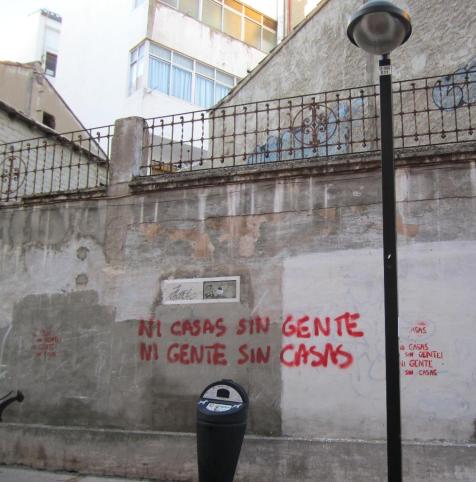
[Last autumn, a new and awful form of protest came to Spain. A string of homeowners on the verge of eviction by court orders and the riot police (antidisturbios) committed suicide by leaping from the windows of their mortgaged houses. The growing anti-eviction movement has altered the dynamic of social protest in Spain, broadening and deepening the opposition to austerity already manifested in the 15M and 25S movements. In the general strike of 14 November, called for by the largest unions, ‘everyone except the Partido Popular and Basque nationalist unions’ poured into the streets. Darío Corbeira, editor of Brumaria, sends the following reflection on the context of the unfolding social struggle. Many thanks to him for taking the time, and to Maria Adelaida Samper for the fine translation. –GR]


Hermeneutic Antidisturbios: 25S, the Anti-Eviction Movement and the 14 November General Strike in Context

By Darío Corbeira


On 25 September, several thousand citizens responded to an anonymous call to surround Madrid’s Congress of Deputies: ‘Surround the Congress, remain there indefinitely. Desert and break with the current regime, demand the dissolution of the entire government, courts and heads of state, and abolition of the existing Constitution. Begin constituting a new system of political, economic and social organization.’The gathering citizens aimed to convey to the parliamentarians their deep opposition to the austerity program of Mariano Rajoy Brey’s governing Partido Popular (PP) and to the interventions of the European Central Bank, International Monetary Fund and European Union. Framing it was a radical critique of the parliamentarism that came out of the so so-called Transition to democracy. As made clear in their manifestos, proclamations and chants, the protesters saw that form of democracy as utterly bankrupt. What began that day has become known as the 25S movement, distinct from but clearly related to its predecessor 15M and the other movements that have emerged from the neighbourhoods, universities, hospitals, cultural centers, and manufacturing areas. All were questioning the perverse effects of neoliberal policies designed by financial capitalism and applied to the letter by the governing authorities. Those effects have shaken the fragile ‘welfare state’ slowly built up since Franco’s death and have undermined all it has achieved by way of diminishing the gaping social and economic disparities that persist in Spain despite the governments of the Partido Socialista Obrero Español (Spanish Socialist Worker’s Party/PSOE).

The peaceful and festive demonstration of 25S, which only pretended to circle the public building and deliver a text addressed to the deputies, was blocked from entering nearby areas of Congress by security fencing and a force of more than 2000 riot police – the antidisturbios. A small attempt to force the fences was enough for the riot cops to unleash a repressive violence not seen in Spain since the last gasps of Franco’s dictatorship. It is worth noting that the Interior Minister, responsible for the State’s security forces, is a prominent member of Opus Dei. Days before the call, both the General Secretary of the PP and the Government Delegate in Madrid were warming up by condemning the foreseeable protestors as ‘violent and anti-system’. This formula, the insult of choice of the authorities and the more reactionary media, now acquires a new and strong semantic value. The demonstration on 25 September ended with more than a hundred protesters wounded or arrested. The latter were packed off to the National Court, a tribunal specifically convened to try crimes of terrorism. This court, however, decreed their release, and the case against them was filed by a writ in which the judge, in an unprecedented act, adopted the words of those who had convened the demonstration: ‘the agreed upon decay of the so-called political class.’ What today is a known secret had burst into view: holding diverging views about the causes and proper administration of the economic crisis of 2008, the executive and the judicial powers are heading for a confrontation. Police brutality and the judicial response gave wings to the protesters, who now began to call themselves the 25S movement.

   
From that point on, in the media and in the spheres of power and its opposition, a debate was generated that was as false as it was unproductive: the debate on ‘violence’- a violence that among the demonstrators was clearly non-existing. Without running away from court dates and futile debates, the activists of 25S continued to convoke new demonstrations to circle Congress, also peaceful, albeit with thinning numbers. By this it gave practical proofs that the crux of the protest and disobedience was not violence, but the subsidiary role that politicians accepted for managing a crisis whose authors were sleeping soundly in the clouds of the financial firmament. The protesters of 25S, as those of 15M had done a year before, were provoking a discussion about the limits of Spain’s capitalist-parliamentarian democracy – about its obsolescence as an instrument for representation. At the same time, demands for new forms of exercising citizenship were put forward, aiming for greater participation in decision-making.

In Spain, as elsewhere, the population had experienced growing rates of unemployment, poverty and precarious employment, in conjunction with cutbacks and the privatization of public services. While public money counted in astronomical figures is being injected into bankrupt banks, the government promulgates a nineteenth-century labour reform, devastates the job security of civil servants and arranges fiscal amnesty for all those who have looted the public treasury. In the middle of it all, the desahucios (foreclosures) erupt, making visible the exemplary struggle of anonymous citizens, supported by a Left recomposing itself outside the countours of Social Democracy. The desahucio is a perversely materialistic legal concept through which citizens are expelled from their houses when they cannot make scheduled payments on the loans they acquired in buying their first longed-for home during the property boom.


From Parliamentary Democracy to Godfathers and Galactic Entrepreneurs

To understand how it has come to this, we must go back to the beginning of the two presidencies of José María Aznar (1996-2000 and 2000-2004), as well as the two of José Luis Rodríguez Zapatero, (2004-2008 and 2008-2011). In the expansive cycle spanning the period from 1996 to 2007, the Spanish economy registered an average annual GDP growth rate of 3.5%, driven mainly by the construction sector. During these years, more housing was built in Spain than in Germany, France, Italy and the United Kingdom put together. And there was in addition an exponential growth in worksof infrastructure and public buildings. All this development took place under the shelter of low interest loans subsidized by the European Union, in conjunction with the neoliberal fiscal policies pursued by the parties in the Spanish government (the PP and the PSOE), and with the Euro as exchange currency. José María Aznar was the architect of the transformation of the PP, a drifting party in the beginning of the 1990s, into to what it is today: the largest political party in Europe. An explosive mix of residual franquismo, Chicago/Harvard neoliberalism and Italian Cosa Nostra, the PP operates an extensive clientelist network of ‘militants’ who occupy, thanks to the method of direct appointment, prominent places and positions in Central, Autonomous and Local administrations. All of this endows the party’s leadership and propaganda apparatus with an hegemonizing power to impose its reactionary and hyper-liberal discourse on political life.

In the expanding cycle of 1996-2007, fiscal and monetary policies were applied in accordance with the so called ‘property boom’. Public entities, banks, construction companies large and small, families and private individuals all entered into a perverse game in which housing prices rose steadily and home ownership produced wealth and guaranties for the future. By 2006, the paradoxical character of this bubble had become visible: more than 2.5 million houses, excessively priced and unsold, sat empty, while at the same time millions of young people, professionals and families were priced out of access to even a small-sized first home. Public housing initiatives were merely nominal, and the big construction companies, supported by indulgent building codes and a continuous flow of cheap money, had a free hand to inflate a rampant market. Meanwhile, taxes on millions of real estate transactions provided the Local municipalities and Autonomous and Central administrations with the economic resources to alleviate public deficits, restructure budgets and increase social expenditures. To supply the vast labour needs of the brick and concrete industries, now growing at an accelerated rate, a cheap low-skilled workforce was needed. And so Spain, which until the middle of the 1970s was still exporting workers to Switzerland, the UK, Germany, Netherlands and Holland, now became host to immigrant labourers from Latin America, North Africa and Eastern Europe. The construction sector, whose motto was ‘more’ – more growth, more money, more public and private works - kept going like this until it ventured into the financial markets, into telecommunications and new technologies, into the oil sector, and into the realm of sports, above all football.


As a tragic anecdote, it is worth recalling that José Luis Rodríguez Zapatero, while still in office, declared that midway through his first presidency, Florentino Pérez (a major construction tycoon and at the time president of Real Madrid C.F.) came to see him at the Palacio de Moncloa and told him: ‘Either you make the Emigration Law more flexible or I’ll go directly to the boats to hire Blacks.’ This disclosure, uttered by Zapatero with his characteristic idiot smile, reveals both the illegal labour practices of an unscrupulous builder and the whole poignant tragedy of the thousand of Sub-Saharans who, seeking places in this overexploited labour market, drowned in the Straits of Gibraltar while trying to reach the Spanish coast.

That Florentino Pérez was also president Real Madrid C.F. is no trivial factoid. It is crucial for understanding this historical period, its suprainstitutional latticework and modes of interaction between economic power and the State – in short, the whole process that led from parliamentary democracy to financial oligarchy. For the third issue of Brumaria (2003), one of the most prominent architects of the PSOE offered this commentary on the already disproportionate property bubble: ‘A central laboratory for decisions was missing, a think tank of neo-conservative thought, and they found it: the box of Real Madrid, the urban cathedral for the new economic and political power, the transversal cockpit of the new order. There they sit together: the politicians (those who let themselves, which are many), the major entrepreneurs of the buddies capitalism that the PP has provided, the King if needed. And there, the politicians of PRISA rub shoulders with recycled unionists, while politicized journalists and galactic businessmen [the Real Madrid football team is called ‘the White Galaxy’ by its fans] cheer the super-transfers that indicate that the network is prospering. In that dammed box, between scores, building floors are reclassified, public works are awarded, companies are sold and decisions are made concerning which candidate from which party is more convenient for the team of the football fans.’


‘The Madrid administrations have gone mute about what makes the discourse public and compensatory in matters of the common, and in that box there is no talk about Madrid (what belongs to all) but of business in Madrid. To them, the city is a cow that needs to be milked and the greatest effort in imagination they are willing to make, consists in packing the cow with more tits than the poor animal naturally has. It is about having enough tits for all the friends of the galaxy. Goal!!’

In that football box, in fact, the sacrosanct alliance was made between financial capital, political power, monarchy and all kinds of monied upstarts. As I write this text in early December 2012, the media are spitting out non-stop the news of the arrest, by order of the National Court, of Gerardo Díaz Ferrán, president of the Spanish Confederation of Financial Organizations(CEOE) from 2007 to 2010. He is accused, among other crimes, of money laundering and concealment of assets following the bankruptcy of his business empire in 2010. Díaz Ferrán was a friend of top politicians in the PP and PSOE, and an overly qualified representative of the predation-and-ruin entrepreneurship that led the growth boom of new-millennium Spain. To him we owe the famous formula, addressed to the unions, for solving the crisis: ‘You have to work more and charge less.’ Some argue that capitalism does not know how to solve the current systemic crisis. But one wonders if this repulsive formula of Díaz Ferrán is not proof that it intends to resolve this crisis as it has all the others before it. The Sunday before his arrest, Díaz Ferrán went to Madrid’s Royal Theater to attend a production of Verdi’s Macbeth. There he met Alberto Ruiz Gallardón, current Minister of Justice (The Godfather, Part IV). The now-incarcerated businessman certainly took note of the dying Macbeth’s final aria in Act IV: ‘Bad for me that I trusted the prophecies of hell.’ Remembering the final sequences of The Godfather, Part III, on the stairs of Palermo’s Opera House, where Michael Corleone’s and Don Altobello’s hitmen resolve their differences with the dialectics of weaponry while Pietro Mascagni’s Cavelleria Rustica plays in the background, one cannot help imagining a group of radicalized militants splintered from the movements, gathering armed and hooded outside Madrid’s Opera to deliver their political message to the powerful thieves who are afflicted by Verdi while they plunge into ruin the Kingdom of Spain.


Money, Death and Desahucio, or The Right to Housing Negated

All through the boom years, works were undertaken on a pharaonic scale: airports were built, high speed trains, universities, museums and contemporary art centres, all drawing on the cheap money dictated by the European Central Bank. In 2008 the sub-prime mortgage crisis erupted and began to spread, exposing the volatility and fragility of social and economic policies steered by hegemonic financial capitalism. Now dragged into the light of day: the criminal activity of its executives and the genuflections before it of the media and the executive, legislative and judicial powers of the Western democracies.  

In Spain, the social effects of the crisis continue to be lethal: 9000 new unemployed every day, one in two young people unable to find a job, the steady rise of public and private debt, the technical bankruptcy of most of the financial institutions, negative economic growth, the systematic dismantling of an already weakened welfare state, the widening of income disparities, and, most dramatic of all, the resurgence of a poverty and misery absent since the late 1950s.


In Spain the narratives (and the portraits) of financial economy, politics and culture coincide; they fade and reappear in the time- and space-unities of the present, tracing the ideological substratum of late neoliberalism. The appearance, subsidence and hibernation of the 15M movement, the eruption of 25S, and the proliferation of social forums and assemblies only confirm that the wretched of the earth have yet to find their Paradise. And what has the long boom to show for itself now: more than three million empty homes, new airports that have closed or that never became operational, high speed train lines shut down for lack of travellers, new university buildings empty and without students. And the museums and contemporary art centres (over 100 museum infrastructures built and launched during the same period)? Like ETA they refuse to die, not wanting to realize that the crisis of 2008 had been preceded, with regard to art and culture, by the exhaustion of the post-Franco model of cultural production. In the context of neoliberal privatization, art no longer fulfils its role as agent of metaphor construction, polltaker of reality, and interrogator of unjust and improvable conditions. Art, as system and institution, emerges now as an integral and collaborative part of the ideological apparatus of a State that administers as it can the disasters of a growth pursued heedless of cost.


In the devastating conjunction of forced judicial evictions, millions of empty houses and the unmet need for housing, all the corrupt and contradictory strands of the crisis and its preludes are woven together. The 1978 Constitution guarantees the right to housing in unequivocal terms: ‘The whole of the Spanish people have the right to enjoy fair and adequate housing. The public powers will promote the necessary conditions and will establish pertinent measures to enforce this right, by regulating the land use in accordance with the general interest to impede speculation. The community will participate in the capital appreciation generated by the urban action of public Entities.’ (Article 47)
    
However, the facts, including all the administrative measures and policies carried out since 1996, violate this article point by point, and ‘the public powers’ have done nothing legislatively or economically to guarantee the right enshrined in it. Consequently, millions in Spain have no access to fair and adequate housing. The successive building laws of the different Autonomous regions have turned all Spanish territory into ‘developable land’, with the exception of specially protected areas. Speculation has been actively encouraged. And of course, there has been no participation whatsoever of the community (what community?) in the capital gain that was generated during the bullish period – the diabolic relation between public administrations, banks, and construction and real estate firms has seen to that. A strict and disorderly speculative relation, in short, sponsored and promoted from the misted heights of the financial framework.


Already this autumn, more than ten people, behind in mortgage payments and facing forced eviction from their homes, have killed themselves. Money and death, hand in hand, are returning us to a tragic Spain that, naively, we thought we had overcome. Are money and death the same thing perhaps? Once more in our heads, that line from Godard’s great Film Socialisme is resounding: ‘Money was invented so that men cannot look each other in the eye.’ The poor wretches who are ending their lives when threatened with eviction by court orders are doing it in the most brutal, poignant and significant way: by throwing themselves from the windows of their own unpaid homes. Before a judge can expel them, they go out by themselves, out of their homes and their lives. Each time he gets drunk, which is quite often, an art critic friend has been declaring, ‘Since the death of Stalin, the working class gets disrespected.’ Years later Alain Badiou tells us, ‘If I can admit Stalin for something, it is because the capitalists were afraid of him.’ Wouldn’t that, exactly, be part of it? That the agents of capitalism have lost their fear of the wretched of the earth?

But the evictions, in numbers that surpass half a million, haven’t appeared from one day to the next. It is at least demented that in a country like Spain, where the rate of private mortgage nonpayment is actually incredibly low, the evictions are being counted in hundreds of thousands and have become a political nucleus of action and reaction that has ended up drawing in all segments of the population. The origins of the desahucios (evictions) must be sought in the years of economic upturn, the era of the real estate boom, when economic, social, demographic and legal factors intersected, ultimately becoming an explosive mix of conflicting interests. The vast amount of housing built with cheap loans and lenient legislation had a referential basis in the Spanish collective imaginary: the dream of owning a home instead of renting it. The growth of mortgaged home ownership led to inflated housing prices and a market in speculation. The majority of the Spanish population, whether to buy a first home or for investment purposes, embarked on property purchases with the fast and cheap money put at their disposal. Some of these buyers were (and are) immigrants who came to Spain seeking their promised land. Already before 2007, the boom should have been seen for what it was - a balloon that could be punctured. Neither the Aznar nor the Zapataro government did anything to slow or deflate it, not even slightly. On the contrary, they encouraged the pumping of more air into it.


In 2007, the first winds of the coming storm appeared in the form of bankrupted financial institutions, millions of empty houses with no buyers in sight, high speed train lines carrying 16 commuters a day, closed airports, technically bankrupt universities and a population of unemployed nearing four million. The ones who first saw the magnitude of the crisis were the banking institutions that had, with cheap money, structured their business on credits and investments in the construction sector, with no hedges on the risks entailed. The results: families and individuals unable to meet monthly mortgage payments, indebted public and private corporations soon in the same predicament, and insolvent public administrations that hadconstantly to go to ‘the markets’ to raise the money to service their debts. In the media, the big subject of the past four years made its appearance: the ‘risk premium’, in the spotlight of an uncertain future. As the State stepped in to cover private sector debt – that of the banks, primarily – the public debt, initially eight times smaller than private debt, started its upward climb. Meanwhile the Kingdom of Spain (in the last days of Zapatero and during the first year of Mariano Rajoy’s government) obediently implemented the measures imposed by the Troika, namely, the wish list of borderless financial capitalism. This delegation of governance and sovereignty to Brussels showed how far Spain’s democracy had become an anachronistic ideological souvenir.
    
All of this should matter little to those citizens who, after losing their jobs and falling too far behind on their mortgage payments, stood facing a judicial and administrative magma that in the end would expel them from their houses: no home, no job, no future. The evictions triggered by mortgage default have been piling up with no distinction made between first homes and housing investments. In force is a Mortgage Act dating back to 1909 and partially reformed in 1946, when the relationship between banks and homeowners was radically different from that of today. In it, all possible guarantees are given to the credit institution for collecting their receivables on the value of the asset in dispute, in this case the home. It is astonishing but true, in fact a real infamy, that if a homeowner cannot pay three instalments of his mortgage, the interest on late payments becomes 29.5%, and applies to the whole of the pending credit, while for that same money the banks have paid a mere 1.5% interest to the European Central Bank. And these same banks, of course, are being rescued and bailed out by public money. In the past four years, banking institutions, supported by this unjust and outdated law, have turned mortgaged property into a surplus-generating commodity, and in this the justice administration has played a key role. The issue now is that the banks, in their drive for capital accumulation and their propensity to usury, have in the last two years begun to lose control over the politics of mortgages and evictions. The articulation of civil solidarity, the 15M movement and the judge’s strike is confronting financial power and the government of the Kingdom of Spain with a new message and demand: evictions are not a Parcheesi game, and the interests of the most vulnerable must be safeguarded. Grounded in the remains of neighbourhood associations and mildly supported by the Izquierda Unida (United Left, IU), civil solidarity found a new impulse in the 15M movement. Militant actions against police and judicial measures began to proliferate.


Now, the protests and political actions of associations like ‘Stop Desahucios’ (Stop Evictions) and ‘Plataforma de Afectados por la Hipoteca’ (Platform of Those Affected by Mortgage) are manifesting a popular power that exceeds by far the merely symptom-signalling discourse of the 15M movement or, more recently, 25S. As the movement against evictions soars, the government and its allied media respond with a smear campaign: they are ‘violent and anti-system’, they are from the extreme left, banks have a duty to collect. Until the matter explodes in one of the three chapels of the system itself: judicial power. The judiciary is of course a traditionally conservative institutional network – the most liberal judges estimate that one in three Spanish judges are members of Opus Dei. But faced with the avalanche of eviction cases, the judges are saying, in effect, ‘Stop, these foreclosures and evictions are turning us into the banks’ collection agency.’ In Valencia, País Vasco and Madrid, the judges are requesting the government to change the laws; threatening to freeze pending cases, they are even calling for a moratorium on evictions. What no one would have dared imagine is happening: the four professional associations of judges and the three associations of prosecutors are all in agreement that the dynamic of evictions must be stopped. Moreover, although for different reasons, they are questioning Minister of Justice Albert Ruiz Gallardón, that wrecker of Madrid, ultraliberal and opera amateur. Even if without fully intending to, those selflessly struggling against the evictions are proving to be anti-systemic insofar as they collide with a System whose supports are crumbling. Rousseau and Montesquieu go on holidays could be the title of the movie. Regarding the Rajoy government’s program of austerity and cutbacks, the Minister of Justice has stated ‘Sometimes the government must distribute pain.’ Were Foucault to resuscitate in this moment, he would kill himself. As one of the fellows at Brumaria puts it, ‘It’s as though we were being governed by the Marquis de Sade.’

    
Questions: Re Pacifism, General Strikes and the Working Class

The Internet, as undiscriminating and random as it is empowering, is full of information and videos about the evictions. Just type the words ‘desahucios’ and ‘antidisturbios’ into any search engine and you will soon be watching clips that constitute the narrative documents of the current social and economical situation in Spain. These documents can and must be interpreted in political terms. Hence, the title of this text: Hermeneutic antidisturbios. The political actors, institutions and subsidiary elements on the ground can all be specified. On the one side, the evicted families, neighbours, anonymous citizens, activists and militants who try to block the progress of the other side, the legal secretaries and experts, locksmiths and officials duly accompanied and protected by units of anti-riot police. Again and again, the story is replayed: action and reaction, peaceful protest answered with violence, screams, running, beatings, people dragged through doors, blows, punches, arrests. Repressive force lurching reflexively to defend public order and, of course, guarantee that each home-commodity returns to the bank.

In all these small unfortunate episodes, the excesses of institutional and police violence are unmistakable. Beyond the interpretation of the obvious, in the functions and character of this violence, the need now is to ask questions about, and perhaps to set some limits, at least theoretically, to the pronounced pacifism of the new movements (of 15M, 25S and others). Similar questions and limits can be posed about the tendencies to treat the assembly-form as a panacea, to discuss horizontality as a paradigm, and to advance anti-politics as new political formula. But all that exceeds the limits of these reflections.

In this context, the largest unions called in mid-October for a general strike against the government austerity program. In the event, on 14 November, the traditional Left party, the anti-parliamentary Left party, the minor unions, the new movements, social forums, everyone joined this call – everyone except the governing PP and the Basque nationalist unions. At a time when the schools, universities, and above all the health sector are in continuously mobilisation, one in every three active workers joined the general strike. Two in every three who did not were prevented from doing so by pressure from employers. And finally, very important, the strike was followed 100% in the large factories and industrial belts. The question that now poses itself is as obvious as it is relevant, and as clear as it is difficult, not to say impossible, to answer: Where is the working class – had it not died, or mutated, or disappeared or been displaced?
    

Or must we, compelled by the evidence of events, speak of the working class as referent, even if without knowing very well (or any more) what we are referring to? Maybe should we forget about its strictly historical meaning, or talk more calmly of proletariat? Or erase it from the counter-hegemonic lexicon, as the inheritors of the inheritors of Autonomia Operaia have been doing? Isn’t it possible that the Working Class after all is refusing to die, even as the Multitude – despite the forceps work and c-sections that Occupy has been performing on the embarrassing pregnancy of political practice – has still not quite yet been born? In a last-minute paraphrase of Jacques Lacan, we are beginning to need a new mode of organizing around this void.

Madrid, December 2012.


Friday, 21 September 2012

capital and biosphere


Modernity and Biospheric Meltdown:
Rethinking Exits, Austerities and Biopolitics

by Gene Ray


In setting out the agenda for this conference, Yannis Stavrakakis calls for a critical and postcolonial reflection on the Greek crisis. He asks us to think about the current politics of debt and austerity within the historical force-fields of “Heterodox Modernity”: “A global crisis provides the opportunity for the enforcement of one more project of ‘modernizing’ Greek culture under circumstances of a quasi-state of emergency.” The terms constellated in this formulation point me to the emerging crisis within modernity itself.
    
My thesis here is that modernity exists but cannot be sustained. It stands exposed today as untenable and unviable – indeed, terminally so. Why? For all the good old reasons set out by critical theory long ago, but also, now, for some new ones. Today, biospheric or ecological meltdown and mass extinction announce the end of modernity. Our challenge now is to rescue ourselves from it: we need an exit from the logic it imposes, not a fix that would prologue it.
    
Given the stakes, which I clarify below, this challenge should be at the very center of political discourse and debate. It should be included now in every serious discussion about the so-called sovereign debt crisis, or art, or the postcolonial. Instead, we continue to leave it out. For many reasons, we’re avoiding this challenge. It’s too huge, too unthinkably catastrophic, too difficult and uncomfortable on so many levels. But avoidance and disavowal won’t make the biospheric crisis go away. It will impose itself now as the absolute material limit of modernity – the real constraining objectivity that will shape all politics, all possible futures.


Limits of a Master Logic.Modernity. What is that, what are we talking about? Is it a process, a logic, an object, a program, an ideology? All of the above: modernity is a global social process that, unfolding, transforms the world. But it’s not a random process; it has as logic. Modernity cannot be separated from the processes of valorization and capital accumulation. Indeed, the history of modernity is the history of capital: from the so-called primitive accumulation of the colonial era to the new enclosures and postcolonial debtors’ prisons of our time. Modernity develops and takes hold unevenly, the pain and the benefits of capital fall differentially, domination is asymmetrical. In this postcolonial sense, we speak of multiple or heterodox modernities.
    
The global social process is the sum of many divergent logics, many tendencies and counter-tendencies, many modes and forms and flows. But there is hierarchy in this force-field: the postmodernist thesis of the death of master logics and narratives does not hold up. The logic of accumulation continues to dominate, integrate and order all rival logics and does so in the most impersonal and indifferent way. Capital, profits, economies must grow, must be made to grow, at whatever cost: this is what we’re living through, the austerity-immiseration program that is devastating Greece and so many other places today is the enforcement of a master logic.
    
The accumulation process is a viciously expanding circle: Marx called it an “automatic subject” – an “animated monster.” It’s not reducible to the greed of bankers or financiers; the current banking and finance system is just a symptom of the master logic. And the pressures of this logic long ago overwhelmed the political process of so-called democracy. Since 1945, technocratic governance has become the norm. In the spectacle of what some call post-politics, politicians provide the faces and personalities, but the important decisions are increasingly made by technocrats - the managers and directors of economies, corporations and war-machines. No need to elaborate here, we’re in the grips of this.
     

From a biospheric perspective, the relentless imperative of growth and acceleration is precisely the problem. The ecological limits of capital have been recognized and probed by a growing group of theorists and writers, including James O’Connor, Midnight Notes, Iain Boal and Retort, Eddie Yuan and Joel Kovel, to name a few. Even some global elites of capital have been worried about the inevitable Limits to Growth, as the study commissioned by the Club of Rome had put it in 1972. These limits are now arriving, and scientists warn us that a real hell is brewing. But it doesn’t seem to matter. Public attention, ever pulled and prodded, remains unfocused and confused, while time after time, the political process fails to confront and address this crisis – as the debacles of the Copenhagen Summit on Climate Change and more recently the Rio+20 Summit clearly show.
    
Two new disarticulations seem to be at work here: the growing gap between science and policymaking and an opening fissure between technocrats charged with planning and risk assessment and politicians bound to short-term election cycles. Rationally, the technocrats should address what is clearly a threat. But the conflicts between risk assessment and the pressures of quarterly earnings reports is already reflected in the divergent positions of the insurance industry and energy sector regarding global warming. But if the technocrats have been unable to bridge these fissures, the main reason is because the master logic strictly forbids it. Aside from the psychological factors that support inaction, we are paralyzed before the biospheric meltdown because acknowledging it calls into question the master logic itself. The solutions cannot be found within the given paradigm of growth and accumulation. The hard numbers, some of which I’ll review shortly, show that “green capitalism” and techno-fixes are rosy delusions.
     

Addressing the biospheric crisis would require a passage to a different social logic, one not based on ceaseless growth and the domination of nature. We need to rethink our "common sense" assumptions about quality of life and standards of living. But this rethinking must go beyond the menu of lifestyle choices on offer in the given consumerism – or, better, the given modernity. We need to work out new enjoyments, grounded in transformed experiences of time and place, and in transformed relations and ways of producing. Collective self-rescue entails changing our values, habits and material relations on a global scale. But the immense investments in the given social process, enforced by war machines, block any such transformation. Besides, haven’t all attempts so far to organize such a passage as an oppositional project failed, or at least been defeated? And yet, that, and nothing less, is what is required.
    
Whatever hope can be found in this impasse derives from the survival imperative. Biospheric meltdown will eventually teach even the most stubborn of us that capitalist modernity has become a terminal race to bottom. Can we stop racing?
     

Adorno and Horkheimer’s Dialectic of Enlightenment is the now classic analysis of how reason, a product of the drive for self-preservation, tends to recoil into a logic of self-repression and social domination. But now there is a new twist to the dialectic. The same drive for self-preservation now becomes a point of counter-pressure that pushes us to find a new social logic. There are no guarantees, of course, but this challenge could potentially bring us together, against the real force of everything that normally tears us apart.
    
The biospheric crisis, like modernity, falls on us differentially. To begin with, the Global South will suffer the most. The wealthy North, by accident of geography and inherited privilege of past crimes, will manage to muddle through. But only to begin with. In time, this maelstrom threatens to pull us all in and under. To grasp this and take it seriously realigns and reorients everything. To be sure, one response to this will be a cynical instrumentalization under the rubric of the politics of fear. New states of emergency and a new official war on terror will certainly be declared at some point. We will have to resist and contain the kinds of bad catastrophism Eddie Yuan and Iain Boal have discussed, even as we engage with the actual catastrophe. 

    
But we clearly have an urgent common stake in global self-rescue. On that basis, just possibly, humanity, which until now has been merely an unrealized cosmopolitan promise, might yet emerge. There is at least an opening here to the good universal, to the shared aspiration to be free of terror and domination. And non-dominating relations to nature would also open up new prospects of ecologically-inflected enjoyments, beyond the pressures of capitalist time. The poet Gary Snyder points to these enjoyments that come with slowing down and taking the time to find out how to inhabit our places; gently, he suggests that we “learn the birdsongs and wildflowers.” We should not assume too quickly that every exit from the logic of growth and consumerism dooms us to an impoverishment of life. Weaning us off our current addictions, the needed shifts would bring different enrichments and foster different values and qualities. Unhappily, we don’t have unlimited time to find the keys to this passage or exit.


Phantasms of Progress. On the level of ideology, modernity has been animated by the myths of enlightenment and automatic progress. The more knowledge and science grow, the better off we are and the closer we approach some vanishing point of total knowledge and ethical perfection. We know it didn’t happen that way. Under the pressures of self-preservation, we developed magic, then myth, then reason, science and technology. These gave us increasing power of mastery over nature, but also became the tools and weapons of societies based on domination and state terror.
    
Step by step, every gain in the domination of nature was turned into a new means for the domination of man by man. This is the dialectic of enlightenment: reason in the service of domination recoils into unreason and distorts the yearning for freedom into actual unfreedom. The division of manual and intellectual labor, in which art and culture is implicated to this day, gives rise to class societies of incredible complexity and, eventually, global scale. Under the regimes of accumulation, certain directions of development tend to win out over others, absorbing and pulling the others into alignment.

    
Adorno saw two dominant tendencies in late capitalism: what he called “integration” and “administration.” Both turn out to be genocidal. Integration denotes the tightening net of social control and the increasing elimination of difference under the reign of identity-thinking. Integration produces forms of subjectivity that deeply internalize the master logic. Administration refers to the expanding powers of bureaucratic concentration and managerial direction – what in the context of today’s struggles against austerity we call technocracy.
    
Under a globalizing social process empowering expansive states and corporations tending toward “total” administration and integration, the process of subject formation is increasingly hijacked. Critical, autonomous subjectivity is increasingly blocked and restricted. Under these conditions accommodation is the subjective imperative: toe the line or risk social banishment or worse. Freedom is the freedom to obey and conform or starve on the streets.
    
The systems of social control become very sophisticated, from culture industry to spectacle. “Commanded enjoyments” are on offer, at least for some: the corrupting phantasms of identity, lifestyle, consumerism and virtuality, as discussed by Yannis Stavrakakis and others. We have learned that the housing bubble and associated derivatives markets floated the illusion that consumerist standards of living could be sustained, even as neo-liberal economics imposed a general precarization of labor and widened the global gap between rich and poor to levels not seen since the nineteenth century. The consumer debt crisis expanded into the sovereign debt crisis, but the ever-hoped for “recovery” confirms our deep shared investment in a system reaching its limits. The wish, that our lifestyles are sustainable, dies hard. We all share, more or less, a stubborn resistance to change that willfully disavows the evidence. In any case, for those who rebel against this menu, there is enforcement. Coercion and violence are applied continuously: probably never in history have we been so tracked and surveilled and made the objects of continuous, official terror.
     

Permanent war and emergency have specific origins in the last century. Auschwitz and Hiroshima are leaps in state terror that signal the end of the myth of progress. They are the proof that modernity itself is genocidal. Auschwitz – and yes, that place name must resonate in very specific ways, here in Thessaloniki – points to a potential for industrialized mass murder lurking irreducibly in the tendencies of integration and administration: a political program is rigorously pursued by combining the standard processes of industrial production with official bureaucratic planning and accounting. Which group or community is attacked is important of course, but is not the essential point. Any group can be targeted. Once demonstrated, this is a potential any state can actualize with the powers at its disposal.
    
Hiroshima actualized a different potential: the terminally genocidal power of weapons systems produced under the merger of science and war machine. Since 1945, this terror has operated on us continuously, even when only deployed as threat. The rise of the vast national security-surveillance state and the administered politics of fear that goes with it, unfolds from the tendency of weapons technologies to overwhelm politics. Together, Auschwitz and Hiroshima gas and bomb the myths of progress and enlightenment. To grasp the implications of these demonstrated potentials is to understand that that they threaten all of us, without exception. There are no more safe places. After 1945, the future itself is in doubt.

Only psychological repression and disavowal of this global trauma, supported by the manufactured optimism of consumerism, can avoid confronting the new reality. And yet avoidance has prevailed. We have not succeeded in understanding, confronting, controlling and eliminating these powers of terror. In fact, they have continued to grow and proliferate – from robotics and drone warfare to nano- and biological weapons of mass destruction.
    
The biospheric meltdown, driven by spiraling growth and production, would appear to be the real endgame of modernity. Now, the imperative of social self-preservation comes into conflict with the instinct for bodily and species survival. Now, evidently, we transform the social logic or allow it to terminate us. Adorno, inflecting Benjamin, set out three entwined relations of domination: the domination of nature, external and internal, and the domination of man by man. All three – the violent plunder of nature outside us, the self-repression of our bodies and psychic processes, and our dominating relations to each other – all are the sites of a struggle not just for liberation but now also for survival. The difficult condensation of these relations is behind Adorno’s quip that “Nature does not yet exist.”
     

We would also, of course, have to register the other qualifications that critical theory has outlined. We need an approach to the biosphere that both is critical and gives scope for feeling and experience. It won’t help to wrap and obscure nature in all kinds of New Age pseudo-mysticism. “Nature” and “the human” are both dynamic, historical constructions rather than static, eternal essences. They are inseparable non-identicals: neither makes any sense except in relation to the other. More, nature and the human mediate, mutually condition and change each other. However, this cannot change the fact that humans have animal bodies that are part of nature and its ecological systems. We cannot escape our dependence on the ecological base. The biosphere remains the inescapable necessary condition for human presence on earth. Or, to express this in Foucault’s idiom: all possibilities for “biopolitics” are bound to and limited by the fate of the biosphere. Strictly speaking, all biopolitics should link up explicitly with the challenge of rescuing the ecological commons.
    
We can know and experience nature and the biosphere in many forms, on many levels. Because the knowledge of nature that science produces has been so powerful, modernity has valued it more highly than other forms. But science, too, is a social fact, with origins in history and subject to historical development. Modernity grants science a relative autonomy, but this has not protected it from the compromising and distorting pressures of the master logic. Undeniably, modernist science has tended to merge with capital and war machine. Corporations and the state fund expensive scientific research, and control over funding has inevitably shaped the setting of research agendas and led to development in certain directions rather than others.
    
Keeping in mind this critique of modernist science, we can note that the gap that has opened between science and policymakers over the biospheric crisis, above all regarding global warming, is a major disruption of these tendencies toward merger with capital and the state. It favors a reassertion of scientific autonomy that should be welcomed. Indeed we might hope the insubordination of climate scientists becomes a more robust correction within a comfortably servile post-Hiroshima scientific establishment. That said, we should not forget that scientists are not critical theorists: they are not routinely trained to critically analyze the social process and their own place within it. We can expect that the biospheric crisis will push many of them to grow beyond this disciplinary limitation.

The very last Rabb's tree frog, in a zoo in Atlanta, 2011
   
Meltdown and Mass Extinction. This has all been terribly theoretical and abstract. Let me try now to make it more concrete. We are all aware of global warming and the scenarios predicted: melting ice caps, rising sea levels, droughts, plagues, rogue storms and massive displacements. Two degrees Celsius is the number widely held to be the threshold of acceptable, “manageable” warming, and this number was even acknowledged by politicians in Copenhagen. Many scientists, though, think this number is too large. James Hansen calls it “a prescription for long-term disaster.”
    
In a recent article for Rolling Stone (2 August 2012) ominously titled “Global Warming’s Terrifying New Math,” Bill McKibben reviews the numbers from new climate simulation models and energy sector reports. We have already raised the planet’s temperature by 0.8 degrees, almost halfway to target. Scientists calculate that we can release a maximum of 565 more gigatons of carbon dioxide into the atmosphere by mid-century and still have a reasonable chance of holding warming to two degrees. At the current rate, as one researcher puts it, “we will blow through our 565-gigaton allowance in sixteen years.”
    
McKibben points out, however, that the proven coal, oil and gas reserves of the world’s largest corporations and states – reserves that are already on the account books, planned for and in-line to be extracted and burned up – is 2,795 gigatons – more than five times the allowance. The worth of those reserves is estimated to be $27 trillion. Under the current logic, there is no chance that $20 trillion of value is going to be left in the ground. Forget about two degrees.
     

We tend to think that warming and climate change are the big problem, but these are but aspects of the biospheric crisis. Pollution, ocean acidification, habitat destruction and loss of biodiversity are also game-changing ecological factors. It is the combination of all these processes, each intensifying the effects of the others, that is crashing the planet and leading to what a growing number of biologists call a mass extinction event.
    
Paleontologists have identified five major extinction events in the earth’s history. The largest of these, the so-called “Great Dying,” was the Permian-Triassic event of 250 million years ago. At that time 90% of all marine species and 70% of all land species went extinct. The last mass extinction was the Cretaceous-Tertiary event that killed off the dinosaurs. That one took place 65 million years ago. Biologists warn us that a sixth mass extinction event is now unfolding, and unlike the others, we ourselves have initiated this one. We are disappearing species at a shocking rate: 100 to 1000 times the background rate, or the rate before humans arrived on the scene, as legible in the fossil record. This is roughly three species every hour. The eminent Edward O. Wilson predicts that the rate of species loss could reach 10,000 times the background rate within the next two decades. A monoculture world of reduced biodiversity and collapsing ecologies is not just an aesthetic and emotional impoverishment of quality of life, it is a survival risk for us as well. No one can say how far a mass extinction will go.
    
Moreover, our response to the extinction of other species is the true ethical test and measure of our relation to the non-human. In 1975, the philosopher and bio-ethicist Peter Singer published his now classic critique of what he called “speciesism,” the bias humans have for valuing the interests of their own species above all others. Singer pointed out that such a bias is no more ethically defensible than racism or sexism. The treatment of the animals we industrially raise and slaughter for our food is a well-known – and ongoing – scandal. The ecological sciences, of course, teach us that consideration of any species outside its context of relations with other species is very problematic.
     

Derrida and others have further unsettled the common sense assumptions and prejudices here: on one hand, the borders separating us from the non-human are unclear, unstable and do not hold up; on the other, our relation to the non-human is a form of our relation to radical difference or otherness. The ethical and political stakes of the latter relation are enormous. If we give ourselves permission, by means of whatever rationalizations, to do whatever we like to non-humans, then the way is clear to reduce groups of people to non- or sub-human status, in order to do what we want to them. This moment, in which a targeted group is pushed outside the category of humanity, is a recurrent one in the history of genocide, and should give us pause in this context.

In the present crisis in Greece, we are justly worried about the treatment of immigrants and the rapid rise of the neo-fascist Chrysi Avgi, or Golden Dawn. Just consider, then, what is likely to happen when millions of new ecological refugees are cast adrift by global warming and climate change, and the imperatives of rapid adaptation begin to pull us through the eye of the needle. The biospheric meltdown is going to constrain politics in very specific ways. The longer we wait to address it, the more likely all moderate and humane options will be squeezed out. If we do nothing and allow the worst-case scenarios to materialize and develop, then the political choices we will face will be very repugnant ones.
     

Beyond Disavowal and Helplessness. Marx had already given us an early, but very important analysis of the human-nature relation. We cannot think of this relation as simply the way we as individuals feel or think about nature. The subjective emotional and affective aspects are important, but the relation operates on a more material, objective and impersonal level than that. The true structure of this relation is found in the way we organize what Marx called the “metabolic interaction with nature”: in other words, how we produce the things that satisfy our basic needs, namely food and shelter. In that primary production is encoded the true facts of our treatment of the biosphere, and everything else, including art and culture, is built on that basis. And indeed, the way we produce the most basic things we need is the problem, from an ecological or biospheric view. A quick look at the global food production system will illuminate the whole ecological problematic and confront us with the scale of the crisis.
    
A recent study in Scientific American (November 2011) analyzed the current food system in light of the challenges facing it. Here’s how this article begins: “Right now about one billion people suffer from chronic hunger. The world’s farmers grow enough food to feed them, but it is not properly distributed and, even if it were, many cannot afford it because prices are escalating.” There are 7 billion people alive now, and 1 in 7 – a billion people – are literally starving. By 2050 there will be 9 to 10 billion people alive and the demand for food is expected to double.
     

Industrio-chemical agriculture – the so-called Green Revolution – has always justified itself by high yields compared to subsistence and traditional farming. But we now know those yields are unsustainable, since they come at extremely high ecological cost. The real justification of the Green Revolution has been the profits produced by this mode of food production. The postcolonial truths are inescapable here: all over the world, over and over again, the new enclosures are driving small farmers and peasants off their land and turning people who were able to grow their own food sustainably into wage laborers dependent on imported food that they cannot afford.
     

The unsustainablities are also well-known. The cash crops of industrial monoculture are drenched in chemical fertilizers and combat-grade toxins. Most of it runs right into streams, rivers and eventually the sea, producing algae blooms and dead zones. Despite the fertilizers, the soil is more depleted with each crop, because the pesticides kill off the good insects and microbes along with the targeted pests and the cycles of soil fertility are broken. 80-90% of all human water consumption is directed to farm irrigation, sucking up aquifers and reservoirs and running many streams dry. Much of the water is sprayed on fields, and much of that is immediately lost to evaporation.

But it is shocking to learn that industrial agriculture is also the largest single source of greenhouse gas emissions – more than other commodity production, more than global shipping and transportation, more than the military-industrial complex or the energy sector. And it’s not just the tractors, pumps and machinery involved: most of the emissions come from tropical deforestation, methane produced by livestock animals and rice paddies, and nitrous oxide released by over-fertilized fields.
     

The scientists’ recommendations include more organic farming and an end to deforestation, more efficient use of resources, a dietary shift away from meat and the reduction of food waste. This is all wonderful advice, but of course Jonathan Foley and his panel of experts has bracketed the problem of capital and the logic of accumulation – this crucial obstacle to change is, no surprise, outside the purview of their study. But the overview at least helps us to see how the productive processes articulate modernity’s real, material relation to nature. To change this – to change the way we live – we need to change the way we produce. It is a question of liberating ourselves from a master logic.

Eating in Public, Honolulu, Hawai'i
What to do? We need to start grappling seriously with these problems among ourselves. How? We probably need to begin, most of us, by looking inside and unlocking some of the blockages that have been preventing us from focusing on the violence and damage being wrought on the biosphere. Critical theorist and psychotherapist Shierry Weber Nicholsen has argued that we all share a love and concern for nature, based on early experiences of intimacy, astonishment and joy; if we avoid too much awareness about what is being done to the biosphere that sustains us, that is because this awareness is deeply traumatic and triggers unconscious defensive responses. Maybe we first need to find the courage to acknowledge to ourselves our own capacities for emotion in this regard, and probably we only begin to do this as we risk sharing our concerns and responses with others. This may involve a surprising recovery of some forgotten bonds and attachments of childhood. Unconsciously, we know how much has already been destroyed and lost; it is for the sake of what remains and can be saved that we need to express and share our grief and distress about it. Rendered productive and politicized, mourning opens a passage to rescue.
     

What is certain is that we cannot wait for the technocrats and politicians to solve the biospheric crisis for us. We need to begin living it as the urgency it is, working it into all our discussions and reflections and shaping it into a daily ethics and practice. On that basis, we build our commons, make alliances, and choose our struggles. If we are artists, our concern will guide our practice: there are many models and precedents, and many still to be invented. Responding to the biospheric meltdown is also going to require coordinated state action – the scales involved make this unavoidable. And yet, largely for the reasons sketched, policymakers are paralyzed and politicians don’t dare confront any of this. So we will have to find the forms of struggle, resistance and invention that move us beyond this impasse.
    
Meanwhile, “lines of flight” are an available “other means” to begin helpfully addressing this crisis at the level of everyday life. The needed ethico-politics, to repeat, must go beyond green lifestyle choices. I don’t want to denigrate conservation efforts and so-called responsible consumerism, but we all understand these micro-efforts do not confront or undo the master logic. Stronger lines of flight are already emerging. Since I sketched the problem with modernist food production, I want to end by mentioning a promising alternative.
     

Permaculture, a form of organic gardening and farming that also fosters biodiversity and remediates ecological damage, offers a much more robust line of flight. Cooperating with, rather than fighting against the ecological principles of natural succession and symbiotic relations, permaculture fosters the growing of edible forests that, when mature, will require no extra water or fertilizer and less labor than conventional forms of cultivation. An integrated movement for safe and sustainable food production, permaculture is a practical subtraction from the profit-driven industrial food system. It can be practiced on any scale, collectively as well as by individuals and families. The more organized and collective, obviously, the better. Permaculture indicates how it is possible to change our mode of production in ways oriented to a non-dominating relation to nature and man. It also offers a radically different basis for autonomy that is highly relevant to debates about sovereignty in Greece and elsewhere today. Something similar is needed all along the line.
     

This is a very quick and cursory treatment, I know. But I’m convinced it’s necessary to keep the biospheric crisis in the discussion, and that critical theory supports and demands our concern about it. Certainly, any serious discussion of modernity has to take it into account. Acknowledging the emotions and understanding the challenge and stakes, we can begin to move on to the possibilities for rescue.

This essay began as a talk at the conference “Art and Politics at the Limit: Claiming a Heterodox Modernity,” in Thessaloniki, Greece, in September 2012, in the context of the exhibition Action Field Kodra.