Showing posts with label FAO. Show all posts

Monday, 7 January 2013

Guide to Investing in Locally Controlled Forestry


Per the press release, the guide “emerged out of 11 international dialogues that assembled more than 400 people to discuss how to make investing in locally controlled forestry (ILCF) happen. It is a primarily a tool for practical action – providing guidance on how to structure enabling investments and prepare the ground for asset investments that yield acceptable returns and reduced risk, not only for investors, but also for local forest right-holders, national governments and society at large. After providing strong justification for this approach, the guide sets out a framework for structuring investments with tactical advice for building the partnerships necessary for successful ILCF.” 

Read more about the guide here. Download the guide directly here.

Tuesday, 27 November 2012

Global irrigated area at record levels, but expansion slowing

KTIC Radio: In 2009, the most recent year for which global data are available from the United Nations Food and Agriculture Organization (FAO), 311 million hectares in the world was equipped for irrigation but only 84 percent of that area was actually being irrigated, according to new research conducted by the Worldwatch Institute for its Vital Signs Online service (www.worldwatch.org). As of 2010, the countries with the largest irrigated areas were India (39 million hectares), China (19 million), and the United States (17 million), writes report author Judith Renner.

...The increasing availability of inexpensive individual pumps and well construction methods has led to a shift from public to private investment in irrigation, and from larger to smaller-scale systems. The takeoff in individual groundwater irrigation has been concentrated in India, China, and much of Southeast Asia. The idea of affordable and effective irrigation is attractive to poor farmers worldwide, with rewards of higher outputs and incomes and better diets.

"The option is often made even more appealing with offers of government subsidies for energy costs of running groundwater pumps and support prices of irrigated products," said Renner, a senior at Fordham University in New York. "In India's Gujarat state, for example, energy subsidies are structured so that farmers pay a flat rate, no matter how much electricity they use. But with rising numbers of farmers tapping groundwater resources, more and more aquifers are in danger of overuse."

If groundwater resources are overexploited, aquifers will be unable to recharge fast enough to keep pace with water withdrawals. It should be noted that not all aquifers are being pumped at unsustainable levels----in fact, 80 percent of aquifers worldwide could handle additional water withdrawals. One troubling aspect of groundwater withdrawals is that the world's major agricultural producers (particularly India, China, and the United States) are also the ones responsible for the highest levels of depletion....

A floating pumping station on the Nile River, shot by Rémih, Wikimedia Commons,  under the Creative Commons Attribution-Share Alike 3.0 Unported license

Monday, 19 November 2012

FAO Study on Women's Role in Livestock Conservation

Via www.fao.org
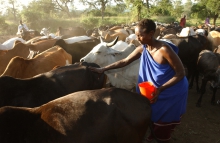
While two-thirds of the world’s 600 million livestock keepers are women, the role of women in conservation and breeding indigenous livestock remains poorly documented and undervalued. A new UN Food and Agriculture Organisation (FAO) study, entitled “Invisible Guardians: Women manage livestock diversity,” seeks to address this shortcoming. 

The report notes the capacity of indigenous livestock breeds to adapt to harsh climates, resist disease, thrive on local fodder, and support themselves with low maintenance. The report argues that the role that women play in conserving and breeding these livestock has been significantly underappreciated. Study author and Natural Justice-partner Ilse Köhler-Rollefson argues that women are the guardians of livestock diversity. The report offers specific guidelines to ensure that gender issues are made central to projects, programmes and policies that focus on animal genetic resource management.

A summary of the report, along with a supplementary interview with study author Ilse Köhler-Rollefson, can be accessed here. The report can be downloaded here. An interview with Dailibai Raika, a livestock activist from Rajasthan, has been produced as a supplement to the brief and can be viewed here

Monday, 12 November 2012

North Korean food harvest improving, but still tight: FAO

Reuters: Food production in North Korea has risen for a second year but the impoverished country still faces shortages and widespread malnutrition, the United Nations' Food and Agriculture Organization on Monday. The U.N. organization forecast a 10 percent increase in the main 2012 harvests and 2013 early season crops compared with a year earlier, and said production was expected to hit 5.8 million metric tons.

The country faced a staple food deficit of 207,000 metric tons, the lowest in many years, but 2.8 million people remained vulnerable to undernutrition, the FAO added.

The body issued its findings after carrying out a mission to the isolated country to measure its cereal production.

"DPR Korea still needs international help," Kisan Gunjal, FAO economist and the mission's co-leader, said in a statement. "The new harvest figures are good news, but the lack of proteins and fats in the diet is alarming."...