Showing posts with label Extractive Industries. Show all posts

Tuesday, 8 January 2013

Paudibhuyan Community of Odisha to Draft BCP

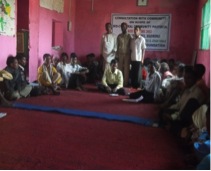
The traditional leaders of the Paudibhuyan community of the Khandadhar region of Sundergarh District in Odisha gathered on 24 December 2012 to prepare a strategy to protect their territory and culture. The meeting was facilitated by Jivan Vikas, a local NGO, and Sankar Pani of Natural Justice. Paudibhuyan is one of the thirteen Primarily Vulnerable Tribal Groups of Odisha, and its population is sharply declining due to various reasons. The community is concentrated in small pockets in the Sundergarh, Keounjhar, Deogaarh and Dhenkanal Districts. At the meeting, the elders of the community shared their rich cultural heritage and traditional knowledge which they have fostered for generations and encouraged their successors to preserve and protect their traditional knowledge. They also raised concerns about various threats to common resources, especially emphasising the impact of mining on local bodies of water. 

The community leaders resolved to draft a biocultural community protocol to record their traditional rights and resources. They demanded recognition of their habitat rights and community rights under Forest Rights Act. They recalled their traditional herbal medicines and recited their traditional folk songs and emphasised the need to preserve them for future generations.

Monday, 10 December 2012

First UN Forum on Business and Human Rights

The first United Nations Forum on Business and Human Rights took place in Geneva from 3-5 December 2012, hosting around one thousand participants from around the world to discuss how governments and businesses are addressing the impacts of business activities on human rights. The Forum was prepared under the guidance of the Working Group on Human Rights and Transnational Corporations and Other Business Enterprises and was mandated to discuss trends and challenges in the implementation of the Guiding Principles on Business and Human Rights, and to promote dialogue and cooperation between actors, including identification of good practices. The Chairperson for the first Forum was Professor John Ruggie, former Special Representative of the Secretary-General for Business and Human Rights

The programme included break out sessions under the banner of “Taking Stock – 1 1/2 years after the endorsement of the Guiding Principles”, reviewing experiences under each of the three Guiding Principles’ pillars. The second day was spent considering the challenges in the implementation of the state duty to protect and business responsibility to respect human rights, as well as the role of civil society and the UN system, and the challenges for business affecting Indigenous peoples and ways forward. Side events were held from 3 December and included “Challenges and Opportunities for the Extractives Industry in integrating human rights into operations”, “The role of the legal profession in promoting implementation of the Guiding Principles”, “Indigenous Peoples and Extractive Industries” and “Impact and remedy of mining on Latin American Indigenous Women”. 

The Forum was attended by participants from 85 countries, including state delegations, business enterprises such as the mining, oil and energy industries and international financial institutions, as well as civil society organisations. A full list of participants can be found here. The full programme for the Forum can be found here. For more information, please see the Forum on Business and Human Rights website here. Natural Justice's recent submission to the Working Group on Human Rights and Transnational Corporations and Other Business Enterprises can be found here

Friday, 7 September 2012

Anaya Report to UN Human Rights Council

From the Special Rapporteur's
Youtube channel
The United Nation’s Special Rapporteur on the Rights of Indigenous Peoples, James Anaya, submitted a report to the UN Human Rights Council on July 7th, 2012. The report summarises the activities of the Special Rapporteur over the past year, including his examination of the thematic issue of violence against Indigenous women, and reports on his continuing study of issues related to extractive industries operating on or near Indigenous territories. 

From the summary, “The Special Rapporteur addresses some issues that have arisen during his consultations over the past year with indigenous peoples, business enterprises, States and non-governmental organizations. In particular, he notes that a focus on the rights implicated in the context of a specific extractive or development project is an indispensable starting point for discussions involving extractive industries operating in or near indigenous lands. In this connection, consultation and free, prior and informed consent standards are best conceptualized as safeguards against measures that may affect indigenous peoples’ rights. The Special Rapporteur also suggests that the “protect, respect and remedy” framework, which is incorporated into the Guiding Principles on Business and Human Rights, should apply to advance the specific rights of indigenous peoples in the same way as it applies to advance human rights more generally.”

Find the full report here. Learn more about the work of the Special Rapporteur on the Rights of Indigenous Peoples here. Follow the Special Rapporteur on Twitter at @unsr_jamesanaya and find his videos on Youtube here

Friday, 31 August 2012

Yanomami Community Members Killed in Clash with Miners


While details are still emerging, it appears that as many as 80 Yanomami community members in the Amazon in Venezuela have been massacred by illegal gold miners. According to a submission to prosecutors this week in Puerto Ayacucho, the massacre occurred in early July. The national prosecutor’s office has appointed two officials to lead investigations, and the Venezuelan military has conducted interviews with witnesses. 

Survival International's Director, Stephen Corry, demanded that Amazonian governments "stop the rampant illegal mining, logging and settlement in indigenous territories." 

Read more from the New York Times here and from the BBC here.

Tuesday, 28 August 2012

Environmental Law Association Conference in Cape Town

Photo via www.elasa.co.za
On 25 August 2012, Laureen Manuel of Natural Justice attended the Environmental Law Association’s annual conference, which focused on the legal challenges facing South Africans in a changing world and country in the context of sustainable development. The conference was attended by environmental lawyers, specialist academics and authors, and government and NGO representatives. 

The conference included five sessions with topics including the 2012 United Nations Conference on Sustainable Development (Rio+20), water and waste law and management, biodiversity conservation, community involvement and energy efficiency, as well as the implications of the South African Maccsand court case which held that mining companies must not only seek permission from the Department of Mineral Resources but also from local authorities if the land is not zoned for mining. The final session included presentations on the challenges and possible solutions relating to planning and environmental law with a specific focus on land use and requisite multiple authorisations.

Friday, 27 July 2012

New film: "Palawan: Our struggle for nature and culture"


Ancestral Land/Domain Watch (ALDAW), a local network of indigenous people struggling for the protection of their ancestral lands against large-scale corporations in the Philippines, has produced a short film entitled "Palawan: Our struggle for nature and culture". The synopsis is as follows:

The struggle to save Palawan (known as the Philippines’ Last Frontier) is not only about saving trees and rare species. It is also about nourishing the Filipino cultural heritage, so powerfully represented by those indigenous communities that - after escaping Spanish and American colonization and while resisting the new ‘mining imperialism’ now - continue to represent the 'living roots' from which all Filipinos originate. According to the filmmakers, environmental plundering by mining companies is not only a crime against nature but it is also a crime against culture, a sort of genocide that annihilates the most profound roots of the Filipino's history and ultimately plunders the cultural heritage of the whole nation. In this film, Kawali, the mythical ancestor depicted by Batak narrators, emphasises humility and trust towards the supernatural beings in charge of animals and plants. On the contrary, the attitude of Kawali’s brother-in-law comes to represent the epitome of inappropriate behaviour, such as the lack of respect towards the mystical keepers of animals and here, specifically, towards the “father of bees”, a relationship that contemporary Batak continues to restore though the lambay ceremony. The sudden switch between the narration of the Batak myth and the threats posed by mining companies serves to introduce the advocacy efforts of ALDAW.

ALDAW would like you to circulate these links amongst your friends and networks and kindly consider signing the following online petitions:


Friday, 9 December 2011

Submission to UN WG on Human Rights and TNCs

On 8 December, Natural Justice and the Centre for Indigenous Knowledge and Organisational Development (CIKOD) made a joint submission on ‘Large-Scale, Industrial Methods of Extraction, Production, and Development and their Impacts on the Rights of Indigenous Peoples and Local Communities’ to the UN Working Group on the Issue of Human Rights and Transnational Corporations and Other Business Enterprises.

The submission documents the varied and significant negative impacts of industrial extraction of natural resources, large‐scale energy and infrastructure development projects, and industrial production systems such as agriculture and fishing on Indigenous peoples and local communities. These impacts include, among others, the violation of human rights, environmental destruction, disempowerment, poverty, displacement, and adverse effects on health, local development, cultures, and tradition.

The submission then elaborates the protections of the international rights of Indigenous peoples and local communities most often violated when companies or governments engage in such activities. It also describes some of the challenges faced by different stakeholders in following these obligations and details some of the work done by communities to proactively assert their rights.

Finally, the submission closes with specific recommendations to the Working Group to ensure Indigenous peoples and local communities are guaranteed the fullest legal protection in these situations.

Download the full submission here. Find other legal submissions by Natural Justice here.