Monday, 13 December 2010

The Importance of Social Class Analysis for Sustainability: Reflections on 'The 'Garden' By Jessica Paddock

Below is a short piece written by Jesssica Paddock from the Cardiff School of Social Sciences at Cardiff University and relates to our sciSCREENing of The Garden in November.

This documentary – ‘The Garden’ - judiciously follows the journey embarked upon by a community of farmers in South Central Los Angeles as they battle notices of eviction issued by the city council on behalf of a powerful developer. The land from which these community gardeners face eviction - ‘loaned’ to the community in order to grow food in what otherwise could be described as a ‘food desert’ - served to enable the community to access fresh and healthy food as well as empowering the predominantly Latino community to exert some control over their means of subsistence in a neighbourhood suffering the consequences of the riots of 1992, also known as the ‘Rodney King Uprising’.

As well as conveying the frustration and despair of these community gardeners as they engage in the necessary legal processes by which to delay and hopefully to prohibit eventual eviction from the land - on the grounds of the illegality of the ‘back room deals’ made between the city council and the landowner – ‘The Garden’ carries the viewer along with the farmers’ heartbreaking journey towards their final eviction, where small and major victories are marred by a spiteful verdict issued on behalf of the landowner.

Despite raising the seemingly impossible sum of sixteen million dollars with the help of celebrity endorsement from actresses and rock bands to eminent politicians at community fund-raisers, these community gardeners were refused the right to purchase the land, despite substantial financial gains to be made on behalf of the landowner. In closing the documentary, a statement made by this powerful developer and landowner is presented via a voiceover as the camera spans across the land vacated by the gardeners that remained untouched by the developer. This statement reads ‘It’s not about money, I don’t like these people, I don’t like their cause’.

Such a distressing ending to the documentary is testament to one theme that has been of particular interest to me throughout my studies; class. The theme of class occurs throughout the documentary as it charts the battle waged by the city council against the plight of urban farmers seeking to preserve their way of life in a devastated neighbourhood of Los Angeles. This theme emerges as clear boundaries demarcate those with the cultural, social and economic capital necessary to fight legal battles that require organisation within the legitimate legal structures - resources held in abundance by lawyers, the city council, and the landowner who provided a contrast to the gardeners, who felt they were initially ill equipped to engage with legal processes. For example, the language of the law and the necessity to speak in English at first inspired little confidence from many of these gardeners. Despite minor – and some major - victories won throughout the legal battle, boundaries were drawn and distinctions were made between the different ways of life that resonate with those often made within the context of ‘alternative’ food consumption here in the UK. In my research, such distinctions of class around issues of food consumption were encountered whilst undertaking qualitative and quantitative research that sought to explore the relationship between social class and the potential success of a sustainable development agenda.

In the UK we have seen a growing number of consumers shopping for food in settings alternative to the conventional retail outlets such as the supermarkets. However, in my research I have sought to understand who shops in such settings and for what reasons, or, more specifically, I have sought to explore the settings of alternative food consumption in relation to whether or not these settings embody any relation to class. Were these spaces of food consumption serving any function that could be seen as reproducing relations of class inequality?

For example, in ‘The Garden’, the community gardeners appear to represent a number of points of departure from discourses that circulate the topics of food consumption and the working classes in the UK. The gardeners of South Central Los Angeles were actively engaged in producing their own food, and through this labour, presented themselves as capable working class social subjects. However, in the UK, the working classes are often - through the lens of popular media texts as well as via data collected in my research – represented as incapable and inactive social subjects, disengaged from the land, from food, and from manual labour.

In light of such disparities it is worth pointing out here that the South Central gardeners had been stripped of a central resource - the land itself - that seemed to enable the enactment of a capable and active self and community. Here in the UK, the loss of the working class labourer is mourned, and their perceived rejection of menial work in the service sector and in traditional working class jobs i.e. producing food, is vilified as evidence of the ‘laziness’ of the working classes who are perceived to have ‘lost their roots’. So, when taking into account these two apparently divergent stories of a connected working class community on the one hand, and a ‘disengaged’ and ‘disconnected’ working class social subject on the other, can we deny the importance of social class analysis in exploring possible avenues towards sustainability?

How, then, in light of such dynamics, can the absence of working class people from settings that engage with alternative forms of food production and consumption be theorised? Moreover, are current approaches to ‘alternative’ food production and consumption sensitive to the politics of class in both a structural as well as cultural sense? To what extent do current practices of sustainable and alternative food production and consumption reflect an agenda that embodies the values and practices of only some classes and not others? These are but a few of the issues explored in my doctoral research.

Friday, 10 December 2010

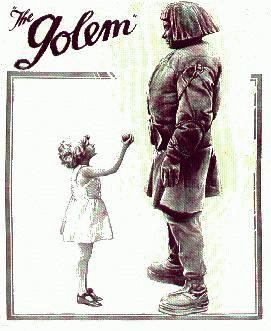
The Golem and Me By Mikel Koven

Below is an essay by Dr. Mikel Koven from the Institute of Humanities and Creative Arts at the Universty of Worcester and relates to our sciSCREENing of Der Golem in October.

I appear to be here as a combination of token film studies expert, token folklorist and token Jew; and that’s not an altogether negative position to be in. I’ve had a close relationship with Wegener’s Das Golem for many years now; it has been a film which seems to follow me around. For example, I wrote the short piece on the film in the book 101 Horror Movies You Must See Before You Die, and when I was curating the St. John’s Jewish Film Society, back in Newfoundland, Canada, it was one of the first films I screened. While only tangentially about Wegener’s Expressionist classic, one of my first published articles was on the Golem legends, particularly its manifestation in an episode of The X-Files (‘”Have I Got a Monster for You!”: Some Thoughts on the Golem, The X-Files and the Jewish Horror Movie’ Folklore 111.2(2000): 217-230). So the mud-man of Jewish folklore has been following me around for some time.


My original proposal for doctoral research was actually on the concept of “the Jewish horror movie”, a good chunk of which would derive explicitly from Jewish folklore. I never wrote that particular thesis, but the idea has never left me, and one of these days hope to actually write that book. So talking about Das Golem is accompanied by a feeling of ‘coming home’.

One of the aspects of this story which has always fascinated me was that it is not simply one story; there is a whole cycle of Golem legends, collected and retold by Chaim Bloch in a collection originally published in German in 1917. A few years earlier, Gustav Meyrink’s expressionist novel, Der Golem (1914), was also published – Meyrink was a compatriot of Kafka’s. So, what’s not to like? It is within this context – of German expressionist literature, art, theatre & cinema, of Jewish folklore collection and Kafka-esque angst – which Wegener’s film needs to be seen.

The Man of Clay By Paul Atkinson

Below is an essay by Professsor Paul Atkinson from the Cardiff School of Social Sciences at Cardiff University and relates to our sciSCREENing of Der Golem in October.

At almost the same time as the film was being made, another version of the golem myth was being transformed into a modern art-work. Nicolae Bretan composed a one-act opera on the topic in 1923. Bretan was the first composer of Romanian opera, being of Transylvanian origin. Based on a poem by Mihali Eminescu, ‘The Ghosts’, the opera is yet another version of a European Jewish myth that has a long history and exists in many transformations. In the opera and the poem, the focus is much more intimate than the film. It concentrates on Rabbi Löw, his grand-daughter Anna and the Golem (whose creation precedes the action). The Golem is in love with Anna, whom he has touched and kissed. She is now gravely ill, as the touch of the man of clay is fatal. The Golem confesses his desire, and begs the Rabbi to give him the remaining power he lacks – the power to procreate. To save Anna’s life, the Rabbi kills the man of clay, ripping from beneath the tongue the fragment of parchment that has hitherto animated him. The opera provides an interesting version of the myth. The Golem himself is the tragic hero of the piece. He and Anna represent two alternative creations of the Rabbi. The Golem’s inability to procreate mirrors the Rabbi’s own creation that itself denies life. It also reminds us that whatever the detail of any given version, the ‘monster’ is always incomplete in some vital way.

In general the Golem is a very variable creature. In some versions, it is a comic figure – clumsy but not malign. In others, it runs out of control like the sorcerer’s apprentice. In the film we see both sides of the man of clay – a helpful domestic helper, rather engagingly doing the shopping, and then out of control, creating mayhem and death. Visually, there are some important parallels with the early Frankenstein of James Whale. But the underlying mythology is very different. The Frankenstein ‘monster’ is created out of science: The body-parts are those of the anatomy schools and their grave-robbers. They are animated by galvanic force – one of the key elements to animate science of the romantic period. The Golem is animated by the word, or more accurately the text. In many versions (as in the opera) it is a word written on parchment. In others (as in the film) it is an amulet inserted into the clay. This representation of esoteric knowledge is diametrically opposed to the science of Mary Shelley’s Creation.

Both versions, of course, give us a vision of an imperfect, incomplete, creation that embodies and yet escapes the creator’s desires. In both, the creature is pathetic rather than horrific. The Golem adds another dimension to the abjection of the creature: by virtue of its Jewish origins, the creature and its creator are both ‘other’, and both need to be controlled – walled up and secluded in the ghetto. When the Golem breaks out of the ghetto walls, it is after all to a world of Christian imagery and blonde children. It is not, I think, necessary to search for specifically anti-Semitic sentiment here to recognise how the Jew stands for an orientalised alterity. Hence the Jewish creature is doubly monstrous.

Wednesday, 8 December 2010

The King's Speech sciSCREEN now January 25th

Our next sciSCREEN we now be on Tuesday January 25th at 6pm in Cinema One of Chapter Arts Centre where we will be screening The King's Speech. Please note that there has been a slight change of date to what was previously advertised.


We currently have 4 speakers lined up - Dr. William Housley and Dr. Gary Love from Cardiff University, Calum Delaney from UWIC, and John M Evans trustee of the British Stammering Association - who will talk to concepts of language and communication, speech pathology, political rhetoric, the mediated public sphere, and the impact of radio and newsreels on the general public.

Tickets for the filming can be bought from Chapter's website. Speakers talks, discussion and debate and the free wine will commence in First Space shortly after the film finishes.
If you would like to be added to our mailing list please send an e-mail to sciscreen[at]cardiff.ac.uk

Monday, 6 December 2010

Monstrosity and the Wolfman in Media and Culture By Rebecca Williams

Below is an essay by Dr. Rebecca Williams from the Communication, Culture and Media Studies Unit at the University of Glamorgan and relates to our sciSCREENing of The Wolfman in March.

Tropes from the horror genre continue to fascinate and frighten us across a range of contemporary media forms including television, literature, and film. Indeed, the final line of Joe Johnston’s ‘The Wolfman’ perhaps sums up one of the questions so central to discussions over the representation of the werewolf, and cinematic monsters more broadly, within media and cultural studies. The final words of the movie echo those uttered earlier in the narrative - “It is said there is no sin in killing a beast, only a man. But where does one begin and the other end?”.

It is this inability to distinguish man from monster – the threat of existing as neither and being in a perpetual state of inbetween-ness – which the horror genre has often tapped into through its depictions of the monstrous. At the centre of this fascination stands the figure of the ‘monster’; the ghost, vampire, or in the case of ‘The Wolfman’, the werewolf. Figures such as these have often functioned as objects of fear due to their ability to straddle the established cultural boundaries which we have come to view as safe and as non-permeable.

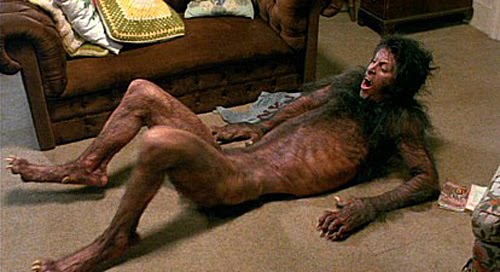
Writers such as the psychoanalyst Julia Kristeva and the film theorist Barbara Creed have suggested that it is the ability of the monstrous figure to violate and threaten such boundaries that is the source of their horror. The figure who can cross between life and death, between male and female or, in the case of the Wolfman, between man and beast has been at the centre of media and cultural studies approaches to horror for decades. In violating our expectations of nature and humanity, such representations continue to attract audiences. For example, the violation of the boundary between man and beast is rendered quite literally in the effects sequences that depict Lawrence’s transformation into the wolf, complete with ripping skin, the extending of teeth and the crunching of bones as the body transforms. This emergence of the animal within quite graphically displays the disintegration of the body’s boundaries.

The famous transformation scene from An American Werewolf in London

However, the werewolf is not always a one-dimensional object of repulsion and terror. The horror genre has always offered more complex representations of the monstrous; presenting figures who might frighten and terrify but who are also often sympathetic characters who elicit our compassion. Throughout horror film’s history characters such as the Wolfman have occupied this dual role of arousing a range of responses and sensations, from fear to empathy and understanding. Within ‘The Wolfman’ there exists such a tension between horror and sympathy for Benicio del Toro’s tormented Lawrence Talbot. The audience may feel repulsion at his acts since the film does not shy away from fairly graphic representations of the bloody violence inflicted upon humans by Talbot in wolf form. Images of blood, entrails, bodies ripped apart are all represented on screen, showing in some detail the destruction of the body of man by the far stronger beast. However, the film also portrays Talbot as a flawed and tragic hero – many of his victims cannot be easily seen as entirely innocent since they include a group of suspicious and intolerant villagers who threaten to kill Talbot and several medical practitioners who have been responsible for tormenting him in the name of science and mental healthcare at an asylum in London. Furthermore, the film also presents an even worse form of monstrosity through the figure of Lawrence’s father John who is characterised as a true villain who delights in the power of the wolf and who urges Lawrence to embrace the glorious possibilities that lycanthropy offers. In refusing to make Lawrence’s character the true monster within the film ‘The Wolfman’ follows the horror genre’s tendency towards representing varying degrees of monstrosity and often limiting the monstrosity of lead characters by constructing an even more horrific and villainous monster who can become the true object of fear and loathing.

Several writers have noted the links between werewolves and femininity due to the connection of their transformations to the lunar cycle and its associations with female menstruation (for example, this is a clear theme in the 2000 werewolf movie ‘Ginger Snaps’). However, ‘The Wolfman’ avoids the potential feminisation of the male via his links to the wolf and instead presents ideas around tragic family legacies and the family/hereditary nature of Lawrence’s predicament, issues of masculinity, and whether human capacity for brutality can in many senses be considered ‘worse’ than that of the beast. Anthony Hopkins’ characters’ delight and joy in the power of his monstrosity contrasts with Lawrence’s obvious pain and regret at the violent acts he has committed whilst in wolf form. Linked to the depiction of the relationship between father and son are issues surrounding masculinity and what it means to be a man and The Wolf Man can be argued to depict masculine struggle with the ‘beast within’. Certain cultural theorists have linked this to issues around identity and subjectivity in which typical patriarchal order can be threatened by the eruption of the un-tamed beast within which disrupts the norms of society.

Furthermore, in one powerful scene between Lawrence and Emily Blunt’s character Gwen, the emergence of the beast is strongly linked to Lawrence’s desire for Gwen. As she dresses his wounds, he becomes drawn to her chest and her neck – suggesting the blood lust of his beastly alter ego but also making a clear association with sexual desire and the impropriety of acting on such feelings. In the nineteenth century society of the film’s world, the repression of the inner beast can be read as a metaphor for the struggle between proper behaviour and natural animal desires. Whilst a range of different interpretations of the film can be made from within media and cultural studies approaches, Joe Johnston’s reworking of ‘The Wolfman’ shows that our fascination with monstrous figures endures, and continues to represent issues around identity, cultural norms, and our fears of those who appear to be able to cross the established cultural boundaries we take for granted within contemporary society.

Medicine, Sensation and the 'Wolfman' By Keir Waddington

Below is an essay by Dr. Keir Waddington from the Cardiff School of History, Archaeology and Religion at Cardiff University and relates to our sciSCREENing of The Wolfman in March.

The ‘Wolfman’ plays on themes that would have been familiar to audiences in the late-nineteenth century when the events of the film are set. Film itself was beginning to make an appearance as an exciting new technology and although representations of the Victorians like to show them as stiff, repressed and controlled, contemporaries were fascinated by spectacle, sensation, horror and the macabre; a fascination that can be best described as the ‘attraction of repulsion’. But it is not just the gothic dimension of the Wolfman that would have been familiar. The film contains motifs that would have had a resonance with concerns current in late-Victorian medicine.
The idea of the lunatic raving at the moon had been established long before the nineteenth century, while representations of insanity as somehow bestial were a central feature of early modern interpretations of madness. Although Victorian psychiatry moved away from these interpretations as definitions of madness were refined to cover a wide range of behaviours, at a popular level notions of the moon and lunacy and of raving maniacs were common, and featured in newspapers and sensation fiction. Of course, the film’s dark representations of the asylum say more about our notions of the Victorian asylum than the nature of these institutions, but fears of wrongful confinement, brutal treatments and the power of doctors over patients were current in the 1890s and were not limited to penny dreadful or sensational journalism. Institutionalisation in an asylum was generally used as a last resort for the dangerous and violent, those individuals whom families, friends and communities could no longer deal with. Although the image of chains, electric shocks and immersion in ice-cold water in the film owes more to eighteenth-century responses to mental illness, hot and cold showers and the resort to various drugs to calm patients were being widely used in the late-nineteenth century, while there was intense contemporary debate about the utility of physical and chemical restraint.

The period also saw the emergence of different ways of conceiving mental illness as new ideas about neurology and neuropathology were put forward, ideas that found expression in debates about the nature of delusions and functional nervous disorders like hysteria. In Paris, Charcot was investigating such ideas and it is him, rather than the films allusions to Freud, that the closest parallels exist, even in terms of how Charcot presented his cases to his fellow doctors. It is here that the film might have a further resonance with contemporary medical concerns - a necessary background to these changing conceptions of mental illness were debates about degeneration and hereditary, the idea that disease or ‘taints’ existed in families, while the theme of the curse was a familiar one to contemporary novels. Alarm about degeneration and hereditary permeated a wide range of disciplines from psychiatry and medicine to social investigations and anthropology and reflected the socio-political pessimism of the period as well as concerns about the feared decline of middle-class fertility, the nation, race and empire.

Other currents in Victorian medicine can be seen – the film plays with ideas of contagion and the blood. We are of course familiar with these ideas from Stoker’s Dracula, but concerns about the nature of contagion, infective agents and germs were being hotly debated in medicine at the time, especially in an imperial context where attention focused on parasites and the native population as a reservoir of infection. At another level, attention was being directed at the nature of the infective agent in rabies and possibilities of a cure, especially following Pasteur’s work in Paris. Stories of wild, rabid dogs featured in newspapers, and the figure of the Wolfman infected with a foreign agent would have struck a chord with late Victorian audiences.

And finally, contemporaries would also have been familiar not only with Inspector Aberline following his role in investigating the Whitechapel murders, but also with debates about the effectiveness of the police, the role of detectives, and the need for vigilantes. The detective was a new breed of policemen at the time, while the Ripper murders focused attention on the powers of police, building on existing concerns about their role and fears of urban crime. A sense that the police were incompetent, that the city was a dark and dangerous place, had seen the creation of vigilante groups in London’s East End in 1888, who, like the villagers in the film, tried to take the law into their own hands and trap the monster.

Of course, it is important to remember that the film is a representation of how we see the late-nineteenth century. However, in terms of some of the ideas, and even in some of the shots which have a similarity with Dore’s images of London, the film would have had a resonance with late-nineteenth century audiences, and given their fascination with the gothic and sensation they, like us, would probably have flocked to see the film.

Wednesday, 1 December 2010

Der Golem sciSCREEN and Reflektor 2 Review by MMP.


Our sciSCREEN sciSCREAM showing of Der Golem on October 31st with musical accompaniment from Reflektor 2 has been reviewed by the Minature Music Press' Simon Read. A short taster of his review is shown below:

"This MMP reviewer has never admired the tricks and treats of Halloween, preferring the absence of this particular unnerving human contact generally experience every other day. So a silent film with a live jazz soundtrack in a darkened room sounded just the ticket...Overall very clever stuff"

To read the full review please click on the miniature music press website.